Showing posts with label review. Show all posts

14 January 2010

Bolshevism and Stalinism

An avalanche of books has recently been published to discredit Lenin, Trotsky and the Russian Revolution. First and foremost of these writers is Professor Robert Service. The aim of his latest book on Trotsky is to prove that Bolshevism leads to Stalinism and totalitarianism. Here Rob Sewell sets the record straight and explains the huge gulf that divided genuine Bolshevism from the monster of Stalinism that was built on the physical destruction of the Bolshevik party

by Rob Sewell | In Defense of Marxism | 13 January 2010

The history of the Russian Revolution is intimately associated with the names of Lenin and Trotsky, its two great leaders. They attracted all the praise and they bore all the hatred. The reason for this is not difficult to understand. The October Russian Revolution, led by the Bolshevik Party, was the greatest event in history. For the first time, the workers and peasant took power into their hands, swept aside the landlords and capitalists, and proceeded to organise a democratic workers’ Soviet Republic. The authority of the new Soviet government rested upon a congress of soviets (workers’ committees) elected from factories and barracks.
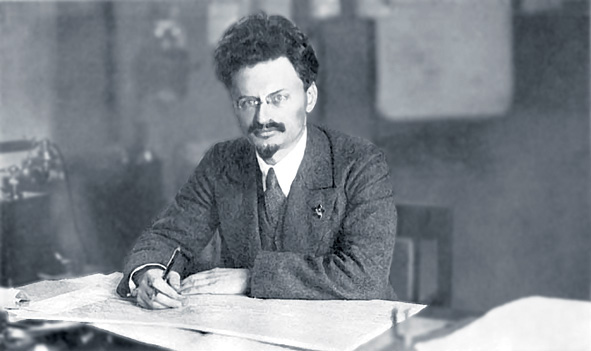
Leon Trotsky

Leon TrotskyLeon Trotsky, who was a political giant, built and led the Red Army from scratch. After Lenin’s death, it was Trotsky who led the struggle against Stalinism, for which he paid the ultimate price by his murder in 1940 at the hands of a Stalinist agent.

Over the recent period there has been an avalanche of books published to discredit Lenin, Trotsky and the Russian Revolution. First and foremost of these writers is Professor Robert Service, the author of several books, including one on Lenin and another on Stalin.

His latest book is a biography of Trotsky, which is an attempt to link all three figures and bind them to the crimes of Stalin. This amalgam is not a new method. Its aim is to prove that Bolshevism leads to Stalinism and totalitarianism and must be condemned in equal measure.

Anti-Communism

Professor Service comes from that breed of historians and intellectuals whose stock in trade is anti-communism. The task of these well-paid academics is to discredit Marxism, communism and revolution in general. Despite all the talk of “objectivity”, Service’s latest book contains nothing that is original, and is a rehash of all the old slanders and gossip against Leon Trotsky, one of the greatest revolutionary figures in history.

Robert Service dismisses Trotsky’s own autobiography, ‘My Life’, as well as the sympathetic and highly acclaimed biographies written by Isaac Deutscher and Pierre Broué, which contain, according to him, “highly disputable judgements”. Service wishes to “correct” these judgements with his own twisted conclusions.

Service is incapable of understanding history through the interaction of leaders, parties, classes and groups. He superficially reduces the historic struggle between Trotsky and Stalin as a personal or even psychological struggle, devoid of any class content or interests. “Stalin outplayed him. Trotsky did not go down to defeat at the hands of ‘the bureaucracy’: he lost to a man and a clique with a superior understanding of Soviet public life.” (p.4). This is to reduce historical events to trivia. Trotsky’s defeat is explained simply by personal failings and not by objective forces.

Liberal dilettantes, such as our learned professor, have never been able to understand revolutions or counter-revolutions. For them, such episodes are “excesses” or “accidents” that have deviated from the “normal” course of history. However, a revolution does not simply fall from the skies. Liberal bourgeois thought is incapable of understanding the movement of the masses and those who put themselves on the standpoint of the working class, as in the case of Lenin and Trotsky. Service could never understand Trotsky or what motivated him, his strengths and weaknesses. His motivation is simply to discredit Trotsky and the ideas he represents.

We are forced to leave aside every calumny thrown against Lenin and Trotsky, as these would require a book to answer. We have chosen to concentrate on the key questions raised by Service. According to the Professor, “Without Lenin, furthermore, Stalinism in the Soviet Union would have been impossible...” (Lenin: A Political Life, vol.3, p.xix). This is the crux of the matter. Were Lenin’s and Trotsky’s methods in essence no different from those of Stalin? Does Bolshevism lead to Stalinism? What was the struggle between Trotsky and Stalin all about?

The answers to these questions cannot be found in individual traits or personal combinations, although they play a certain role, but in the complex relationships between classes and different social layers and the objective conditions that predominate at the time.

Lenin’s and Trotsky’s lives were bound up with the revolutionary struggles of their age: the fight against tsarism, the development of Russian Marxism, the 1905 Revolution, exile, the war years, the revolutions of 1917, the conquest of power, and the founding of the Communist International. Trotsky lived on in the fight against Stalinism and the preparation for a new revolutionary international.

Revolutionary Struggle

In his outstanding autobiography, ‘My Life’, Trotsky explained “Thus I know well enough, from my own experience, the historical ebb and flow. They are governed by their own laws. Mere impatience will not expedite their change. I have grown accustomed to viewing the historical perspective not from the standpoint of my personal fate. To understand the causal sequence of events and to find somewhere in the sequence one’s own place – that is the first duty of a revolutionary. And at the same time it is the greatest personal satisfaction possible for a man who does not limit his tasks to the present day.”

Trotsky’s fall from power after Lenin’s death did not represent personal ineptitude but the changed relation of class forces in Russia and internationally. The victory of Stalin reflected the isolation of the revolution in a backward country, surrounded by hostile forces.

In Robert Service’s account of October, which he typically regards as a “coup”, there is one essential ingredient missing – the role of the masses on which the revolution is based. In the aftermath of the revolution, Service concludes “Most people in Russia and the rest of the world regarded the Bolshevik leadership as a gang of wild incompetents who could never sustain themselves in power.” (Service, Trotsky, A Biography, p.189). This is the view of the ruling classes, which Service takes as representing “most people”, but certainly not of the international working class which rallied to the cause of the Russian Revolution.

“Bolshevism,” explained Victor Serge, “is the unity of word and deed. Lenin’s entire merit consists in his will to carry out his programme... Land to the peasants, factories to the working class, power to those who toil. These words have often been spoken, but no one has ever thought seriously of passing from theory to practice.” (From Lenin to Stalin)

This was the essence of the revolution. In the civil war and imperialist intervention, the main aim of the imperialists was the violent overthrow of the revolutionary government and the murder of its leaders. In August 1918, a Social Revolutionary (member of the peasant party) shot and nearly fatally wounded Lenin. Trotsky was also the target of repeated assassination attempts by the White generals.

The first Soviet Constitution guaranteed every freedom for the workers. There was no thought whatsoever of a totalitarian state. All political parties, including the capitalist parties, were free to operate, accept for the fascist Black Hundreds. There was complete freedom of discussion and debate within the Communist Party. On the issue of the Brest-Litovsk proposals to sign a predatory peace treaty with Germany in 1918, for instance, Lenin was in a minority. He put forward the proposal that every group of citizens supported by 10,000 – 15,000 workers should have to right to issue their own paper if they wanted, the only way to democratise the press.

The October Revolution was largely a peaceful affair. “Hardly anyone was arrested”, noted Serge, “and those who were, were soon released. Among these were Krasnov, Ataman of the Cossacks, who took advantage of our leniency to start a civil war in the Don country – and Purishkievich, the anti-Semite leader.” (Ibid) The revolution was still very naive. As soon as these reactionaries were released they immediately took up arms against the workers’ state.

The first Soviet government was a coalition between Bolsheviks and Left Social Revolutionaries, a left wing split off from the Social Revolutionaries. This only came to an end when the Left SRs joined the Mensheviks and other counter-revolutionaries, and took up arms against the government. Only after the summer of 1918 did the revolution hit back in self-defence. Trotsky organised the Red Army in order to defend the revolution.
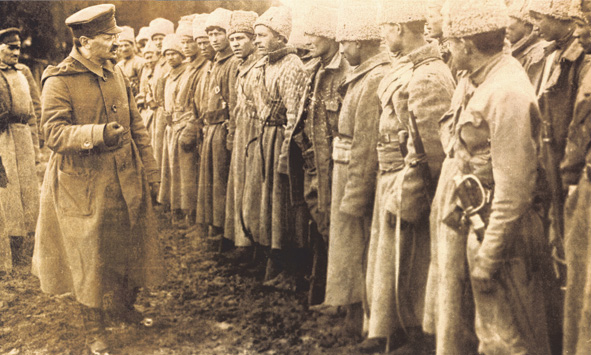
Leon Trotsky addresses Red Army troops during the Civil War, 1918

Leon Trotsky addresses Red Army troops during the Civil War, 1918“Lenin and Trotsky had become the Siamese twins of Russian politics”, states Service, “being joined at the hip in their determination to use ruthless measures including state terror against enemies.” (Trotsky, a biography, p.190). However, in a situation of civil war and imperialist intervention to overthrow the Soviet government, what were they to do, simply fold their arms and pray the counter-revolution would go away?

The counter-revolutionary White forces, backed by 21 foreign armies, took most of the country and carried out wide-scale atrocities against the workers and peasants. At one stage, the Soviet government only controlled Moscow and the surrounding area. The fate of the revolution was hanging by a thread. Trotsky succeeded in turning the situation around, but at enormous cost. War production and famine necessitated rationing in the cities and requisitioning in the countryside. This is the period of “war communism”, where everything was directed unavoidably to the war effort and military defence of the Soviet Republic.

Kronstadt Mutiny

This served to stretch things to the absolute limit. Relations between the peasants and the workers, the cornerstone of the revolution, reached breaking point. Peasant uprisings broke out in 1920 and early 1921. At this time the Soviet government was faced with a naval mutiny in Kronstadt. They had no alternative after negotiations broke down but to crush the rebellion. Failure to do so would have opened the door to military intervention against Petrograd. These Kronstadt sailors were not the same revolutionary sailors of October 1917, but new peasant conscripts under the influence of the counter-revolution. With the end of the civil war, the New Economic Policy was introduced to placate the peasants, allowing them to sell their surplus produce, which succeeded in bringing stability to the countryside.

In this life or death situation, the Bolsheviks had no alternative but to take emergency defensive measures. Incidentally, the same was true of Cromwell’s actions in defence of the English revolution against the Royalist reaction, or Robespierre’s defence of the French revolution against the feudal regime, or the measures of the Northern states against the slave-owning owners in the American civil war. “A party which had seemed doomed to defeat in mid-1918 triumphed by dint of determination, organisation and leadership”, admits Service. (Trotsky, a biography, p.245). But then goes on to attack such measures as “ruthless” and “terror against its enemies”.

The overthrow of the Soviet government would not have brought with it liberal democracy, but the military fascist dictatorship of the White generals. That was the alternative to Soviet power that the imperialists desired.

The Bolsheviks, while defending the revolution at all costs, never believed the revolution could be sustained for any length of time in a backward country like Russia. The fate of the Soviet regime depended upon the world revolution. Lenin believed that if the isolation was not broken, the Russian revolution would be doomed. He was prepared to sacrifice everything for a successful revolution in Germany. The only thing they could do was to hold on as long as possible until help arrived from the west. As we saw, the revolution did not collapse as Lenin had feared, but suffered a bureaucratic degeneration in the form of Stalinism.

Stalinism – the opposite of Bolshevism – grew precisely out of these objective conditions of isolation and terrible backwardness. After the civil war, the economy was completely shattered. The country was ruined and subject to famine and disease. The working class had become atomised. “The terrible crises and the closing down of factories have compelled people to flee from starvation”, wrote Lenin. “The workers have simply abandoned their factories; they have had to settle down in the country and have ceased to be workers.” (Collected Works, vol.32, p.199)

The introduction of the New Economic Policy in 1921 was a retreat, which gave concessions to the market. It saw the revival of capitalism in Russia, together with the merchant, petty employer, rich peasant and black marketer. This went hand in hand with the growth of bureaucratism in industry, the state and even the Bolshevik Party. Stalin, who was a secondary figure in the revolution, became the spokesman for this new social layer that was elbowing aside the working class.

State Apparatus

“Our state apparatus is so deplorable, not to say wretched, that we must think very carefully how to combat its defects”, complained Lenin. (Collected Works, vol.33, p.487). Things became so bad that Lenin and Trotsky formed a bloc in 1922 to fight the menace of bureaucracy. This struggle led to Lenin breaking off all personal relations with Stalin. Lenin stated he was preparing a “bomb” against Stalin. Finally, in his last ‘Testament’ Lenin recommended the Stalin be removed as General Secretary of the Communist Party and recommended Trotsky “as the most able man on the Central Committee”.

The wishes of Lenin’s Testament were not carried out due to the personal intrigues of both Kamenev and Zinoviev, who had made a rotten pact with Stalin to keep Trotsky out of power. Here we see the pernicious role of spite in politics and its unforeseen consequences.

Lenin’s death in January 1924 coincided with the defeat of the German revolution, which provided a double blow to the morale of the Russian workers. At this time, only one percent of the members of the Bolshevik Party had held a party card before March 1917. Many of the advance workers and communists had perished in the civil war. After these blows, through the agency of Stalin, the bureaucracy took control of the party and state apparatus. The weight of the Nepmen (petty capitalists created by the New Economic Policy) and kulaks (rich peasants) grew exponentially. The pressure of these hostile class forces fed into the party through the rising bureaucracy.

In late 1924, Stalin came forward with his anti-Marxist theory of ‘Socialism in one country’, which reflected the conservative outlook of the bureaucracy. This represented a complete break with the perspective of world revolution as put forward by Lenin. It also coincided with a campaign to discredit Trotsky who had established a Left Opposition in 1923 to restore party democracy.

Trotsky defended the position of revolutionary Marxism against the growing revisionism of Stalin. While Trotsky’s support rested upon the revolutionary workers, Stalin’s was based upon the bureaucratic reaction, the millions of petty officials, former tsarist functionaries, tsarist officers, bourgeois intellectuals, and so forth, who made their living in the apparatus of state, industry and party. Stalin became the “chief” of this caste, which now had its own material interests to defend. In 1926, when Lenin’s widow Krupskaya was close to the Opposition, she stated “If Lenin were alive today he would now be in prison.”

“Whoever understands history even slightly knows that every revolution has provoked a subsequent counter-revolution which, to be sure, has never completely thrown the nation all the way back to its starting point in the sphere of the economy but has always taken from the people a considerable part, sometimes the lion’s share, of its political conquests”, explained Trotsky. “And the first victim of the reactionary wave as a general rule is that layer of revolutionaries which stood at the head of the masses in the first period of the revolution, the period of the offensive, the ‘heroic’ period. This general historical observation should lead us to the idea that the matter is not simply one of the skill, the cunning, or the art of two or a few individuals, but of incomparably more profound causes.” (Trotsky - Writings 1935-36, p.171)

Stalin’s Revisionism

The years of hardship and defeat had borne down heavily upon the Russian masses. As the bureaucrats grew in power and insolence, the voice of the revolutionary workers became weaker. While the Bolshevik-Leninists around Trotsky drew to their banner tens of thousands of the best revolutionary fighters, and gathered sympathy from the advanced workers, this sympathy remained passive. They were exhausted and only a victory internationally could have stirred them into life. Meanwhile, the Stalinist bureaucracy railed against “permanent revolution” internationally and unnecessary upheaval at home. “We will build the socialist society in Russia!” they proclaimed. This found an echo in the weary and backward masses, which served to isolate the Bolshevik vanguard. “Therein lies the secret of the victory of the bureaucracy”, explained Trotsky. “Power is not a prize which the most ‘skilful’ win. Power is a relationship between individuals, in the last analysis between classes.” (Ibid, pp.176-77).

Dominant Position

Stalin used his dominant position to expel and exile Trotsky from the Soviet Union. By the mid-1930s, despite all the capitulations of former oppositionists around Zinoviev and Kamenev, Stalin decided to eliminate physically all those connected with the October revolution. The developing revolution in Spain was threatening to rekindle the enthusiasm of the Russian masses. This would have sounded the death-knell of the bureaucracy. As a result, Stalin waged a one-sided civil war against the Old Bolsheviks. This culminated in the purge trials of 1936-8, where those associated with October were physically eliminated. Millions perished in the camps and cellars of the secret police. For those who say, as Service does, that Bolshevism leads to Stalinism, we say that on the contrary, a river of blood separated Stalinism and Bolshevism.

The only way Stalinism could consolidate its rule was over the corpses of those communists and Trotskyists who remained true to the ideals of October. Trotsky fought Stalinism to the death. He refused to capitulate, as this would only serve to discredit the ideas of Marxism. Trotsky paid for this with his life.

Clean Banner

Despite all the terrible odds, and the murder of his close family and collaborators, Trotsky continued to defend the clean banner of Marx and Lenin against the horrors of Stalinism right up to the bitter end. The likes of Professor Service are repelled by this. Even Deutscher failed to understand the real Trotsky, believing he should simply concentrate on writing and not bother himself with organising the forces of a new revolutionary international. However, Trotsky regarded this task as the most important work of his entire life.

Despite the death of Trotsky, his ideas live on. The collapse of Stalinism, which he predicted, and the global crisis of capitalism, will once again make these ideas the most attractive ideas in the world.

“Time was when Trotsky was a frequent topic of public discussion at least outside the USSR. Those days are gone”, states Service. However, in today’s crisis, things are changing. There is a renewed interest in Lenin, Trotsky and their ideas. It is for this reason that Service has published his books. But they will have little effect.

We should study Trotsky’s writings, alongside other great teachers of Marxism, which are a treasure house of experience and theory. With these, the new generation can find the way forward in the eventual overthrow of capitalism and the establishment of world socialism. As for the likes of Professor Service, in the words of the Bible, let the dead bury the dead.

14 October 2007

Four Micro-Interventions into Neoliberal Globalization

Kiel Hume

Original URL

I. Spectacle and Theory’s Images

In 1936 Walter Benjamin published his widely read essay “The Work of Art in the Age of Mechanical Reproduction”. In it he ponders the new kinds of images available to the world, taking a curiously optimistic stance on the issue of film. He sees the world and politics becoming increasingly inaccessible, until “Then came the film and burst this prison-world asunder by the dynamite of the tenth of a second, so that now, in the midst of its far-flung ruins and debris, we calmly and adventurously go traveling” (Benjamin 236). Benjamin’s view of the revolutionary possibilities represented by the transformation of images and the earliest examples of spectacle can only seem naïve by our contemporary experience of what these changes have actually become. His essay poses fascism against communism, and the possibility of both to utilize the changes in visuality taking place in the early twentieth century. Unfortunately, Benjamin doesn’t recognize (at least here anyway) the potential the new state of images represents for the forces of global capitalism.

Today we are only too familiar with the role the spectacle plays in our lives and the world. Far from the liberating possibilities imagined by Benjamin, the spectacle operates by an excess that fundamentally transforms the conditions of subjectivity; this is a process of “immense accumulation” of representation, of a visuality that is valued solely for its form and lacking all traces of content (or is it perhaps all content lacking any form?). Life and politics become static, aestheticized into “an object of contemplation” in which perceiving is taken as experiencing: “All that was once directly lived has become mere representation” (Debord, The Society of the Spectacle 12). We must be careful, however, not to elevate this phenomenon to the realm of the metaphysical; this is a material reality that is abstracted and experienced spectacularly. For Debord, “spectacle epitomizes the prevailing model of social life” (13), that is, a cultural and social experience based on accumulation, distance, and alienation.

While life becomes increasingly constricted by its penetration on all sides, the spectacle itself transforms. The spectacle is materialized as it enters reality, functioning beside and throughout all aspects of life before it is deified, transformed absolutely into Debord’s trinity of “society itself…a part of society…and a means of unification” (12). Yet, even at this point the process is not complete. Debord himself retheorizes the spectacle’s evolution into an integrated state (Debord, Comments on the Society of the Spectacle 8), bringing to mind prevailing contemporary models of integrated business solutions, that is, making—in the most productive sense—connections in the name of efficiency where before there were none.

But what has this to do with neo-liberal culture? To answer this I turn to another well known spectacle, yet one that is not generally characterized as such. Michel Foucault opens Discipline and Punish with the very public spectacle of the regicide’s torture and execution, noting the minutest details of bodily mortification and subjectification, both literal and symbolic. This disciplinary spectacle is quite different from Debord’s spectacle of global capital and accumulation, yet they are both concerned with transforming the body and mind at the very levels of subjectivity which one encounters and experiences the world. A spectacular reality is in many ways similar to Foucault’s notions of the panoptic society. The subject is still caught in a specifying spotlight, only added are sounds and images. Surveillance is not actually necessary as long she/he is constantly accessible to the images being projected into all corners of reality; in fact, the very principle of surveillance is reversed, since it is the subject of power who is now the viewer and no longer the viewed. The process of the spectacle’s hold over the subject is at once global in its totality, as well as completely individualizing, the ultimate corruption of democracy from which no individual is excluded, offering something for everyone, “such that all demands, all tastes are satisfied” (Bourdieu 68). The panoptic principle, transformed into a spectacular one, is ultimately an applied marketing model: the prison bars are replaced with the all-mediating image, the family television is the accepted way of encountering others, and the public is subsumed into the private.

It is only by a process of separation (of individuals from one another, from their material and conceptual conditions for the (re)production of the political, economic and cultural world in which they live) that has been almost completely perfected that allows for today’s global inequalities to exist. Like Foucault’s spectacle, today’s is also disciplining and pacifying, a unidirectional flow of power that seeks out subjects in the everydayness of their lives. Indeed, this system places the entire weight of the world on each person’s shoulders, with seemingly no solidarity or collective strength to resist. The spectacle functions by virtue of one of neo-liberalisms primary goals: by assessing and accessing individuals while diluting the idea of people. Thus, resistance can only be possible by seeking out and encountering real human beings and their real struggles.


II. Subsumption and the State of Capital Accumulation

Marx characterizes the phase of primitive accumulation as that “which precedes capitalist accumulation; an accumulation which is not the result of the capitalist mode of production but its point of departure” (873, my emphasis). Thus primitive accumulation is a transitionary phase, a point of rupture with past forms of political and economic organization. Preceding capitalism but leading directly too it, primitive accumulation is the originary moment the effects of which allow for capitalism to proceed and thrive. More recently, Hardt and Negri stress a break with the past represented in what they see as an entirely new phase of accumulation. Arguing against the highs and lows of a cyclical theory of capital’s development, they instead envision us as entering a new period, a fracture leading to a new form of capitalism, or a form that is at least fundamentally transformed in its field of operation and exploitation. Marx also notes that primitive accumulation, this “process…which creates the capital-relation can be nothing other than the process which divorces the worker from the ownership of the conditions of his labour” (874). It would seem that the neo-liberal moment is one of revisiting the underlying notions of primitive accumulation, that is, of subsuming under capital those aspects of (global) society that have until recently fallen outside of the direct control of a capitalist mentality, further divorcing the world’s producers and laboring classes from the means of social—indeed, in some cases biological—(re)production and subsistence. This process today takes the form of neo-imperialism on the global scale and privatization domestically (though privatization can operate on an equally global or transnational level). If these assessments are correct, then a new “point of departure” is at hand in a new kind of primitive accumulation.

The state’s role in this process is of central importance. David Harvey notes that the “chronic problems of overaccumulation of capital through expanded reproduction coupled with a political refusal to attempt any solution to these problems” has led to the current neo-liberal state mentality that if we just allow the market the freedom to regulate itself, it will at the same time resolve domestic economic and resulting social tensions. The question of overaccumulation, of what to do with bored capital (to put it crudely) is posed in capital’s own terms of expansion and profitability. The result is gluttonous amounts of accumulation channeled into the creation of new markets and domains of profitability, the desire to be able to sell absolutely everything to everyone. Of course new markets are not actually created (as if from thin air!) but rather are claimed from those existing aspects of society that are shared through state distribution. The accompanying result is a dismantling and subsumption of any and all social commons. Privatization allows for this new corporate owning of public goods and services, stripping the people of what they have traditionally owned collectively through the democratic state. The people find themselves continually engrossed within expanding networks of accumulation. The body’s conditions of existence increasingly exist within a realm firmly controlled by capital as scientific advances leading to cures are patented, and agribusiness’ bio-chemical sectors claim (legal!) ownership over the micro—genetic makeup—and macro—costs and subsequent distribution—aspects of the world’s food supply. Today advances that benefit humanity are quickly packaged and placed on a shelf too high for most of the world to reach.

What then is the role of the state today if it has freed itself of responsibility toward its citizens? The state is by definition part of the world stage, an entity that is both national and transnational in its occupations (in both senses of the word) and actions. If the state bows to the demands of capital and allows capital to freely express itself throughout the globe, then are we really witnessing Hardt and Negri’s claim regarding “the full realization of the relationship between the state and capital” (236)? It seems that capital is the privileged party in this relationship: capital takes on more and more of the characteristics, capacities, and responsibilities of the state, while the state becomes more and more a material and ideological apparatus for the maintenance of capital’s freedom. There is a hideous irony in the American example (to take just one) of a state that shakes the world with its hegemonic weight in the name of its citizens’ safety and security, while healthcare and education, those very apparatuses of the (re)production of a productive citizenry, are sold off to the benefit of corporate profits and at the expense of those citizens whose well-being is supposedly of the utmost importance. Freed from the yoke of its own citizenry, what distinguishes the state from the corporation if both are merely concerned with their own protection, reproduction and expansion?


III. Power’s (Global) Sphere and the Crisis of Biopolitics

Power relations are both intentional and nonsubjective. If in fact they are intelligible, this is not because they are the effect of another instance that ‘explains’ them, but rather because they are imbued, through and through, with calculation: there is no power that is exercised without a series of aims or objectives. --Foucault, The History of Sexuality Vol.1, 95

Taking Foucault’s claim into account what can we say about globalization and neoliberal culture? If we know, or at least have an idea of what capital’s goal is in the current moment, then where do we begin to direct our theory or practice? If we understand that the “aims or objectives” are that of infinite accumulation, or perhaps a drive toward investing (in) every body and space on the globe with the hopes of extracting some type of return then what is there to say first?

The power relations functioning within globalization are a field of global corporeal relations; of bodies to one another, bodies to nations, bodies to corporations, and bodies to deprivation. The body, and its utility as a force productive and exploitable, is the site of both globalization’s generation and the constant threat of crisis. For a system with a goal of infinite accumulation, bodies must be effectively maintained to achieve maximum production. Sadly, however, the body’s productive capacities are often hindered by certain unproductive tendencies such as death and illness. When Foucault introduces biopolitics it is to theorize how power, traditionally concerned with the micro level of the singular body, expands to a macro level concerned with clusters of bodies: “Biopolitics deals with the population, with the population as political problem, as a problem that is at once scientific and political, as a biological problem and as power’s problem” (Foucault, Society Must be Defended 244). This does not mean that the macro subsumes the micro, but rather is an extension to accommodate new and changing conditions. Biopower invests in populations insofar as to maintain and protect capital’s investment in that population.

For it is the changing conditions in which the body finds itself early in industrial capitalism’s genesis that are at issue. The body, moving into a new system of capitalist and industrial relations (spatially and conceptually), finds itself amongst bodies as populations in and around urban centers representing complex new problems for power. Foucault locates the question of space and “control over relations between the human race, or human beings insofar as they are a species, insofar as they are living beings, and their environment, the milieu in which they live” (Foucault, Society Must be Defended 245) as central to biopolitical concerns; where and how people live, what relations they have to one another, and the conditions produced take on new importance for power.

It seems there is something of a crisis for capital in its relation to biopower. Biopower is a form of power that we can broadly attribute to the rise of capitalism, that is, of industrialization and urbanism and negative effects on populations. Here we have a number of crises that must be addressed, such as health problems due to working conditions and sanitation issues resulting from urbanism. Reforms must be made in the name of biopolitics to ensure the health and safety of populations; reproductive capacities must be secured. Yet, here is the crisis of biopolitics for capital: reforms disrupt the necessary flow and exploitation on which capital rests, disrupting the very mechanisms of an ever-increasing amount of return. The result is one of the primary factors behind the move towards globalization. As biopower begins to hinder capital, capital moves offshore to spaces not burdened by (biopolitical) labour reforms. Biopower and capital thus work for and against one another, are immanent in yet counterproductive to one another. While biopower ultimately manages bodies in their potential as productive forces, capital manages bodies as productivity and material output. A recent example of the crisis provoked by these two disciplinary mechanisms is the proposed Chinese labour reforms and the outrage voiced by U.S. corporations explored in a recent article in The New York Times (Barboza). Capital’s logic only distinguishes between addition and subtraction, losses and gains. While the biology of the producers can to some extent be taken into account for producing gains, the humanity of the producers will always equal a loss for capital.


IV. Utopian Desire and a World without End

What do we do when Utopia, this critical “literary Golem” (211) to use Jameson’s characterization, this savior form that we create out of the dust and dirt of an ever increasing planet of slums, is co-opted and subsumed under neoliberal discourse? If the “proper function of its themes lay in critical negativity, that is in their function to demystify their opposite numbers” (Jameson 211), imaging what is not and what could be, then the discourse of neoliberalism endlessly esteems what is and what will be in the future as envisioned by capital. It seems that there are two kinds of utopia at work today: that of the neoliberal capitalists, who tell us that the current system works, that it will only get better and make life better over time; and then there is the narrative of the post-capitalist utopia, that capitalism will implode and the world will be set free to explore new, more equitable realities. This latter utopia is a break that can only be brought about with the efforts of those who are willing to work toward the unknown, in the direction of an uncharted geopolitical order. If, as Jameson suggests it is indeed easier to imagine the end of the world than it is to imagine the end of capitalism, then our task is to conceive the inconceivable and work, not towards a final goal, but towards a series of breaks that will lead us into the oblivion of an unshaped, unimagined future.

On the other hand, the first of these utopian narratives, the neoliberal capitalist version, is a teleological narrative: the world’s historical trajectory is firmly in place and building towards a time beyond time when capital will have solved all of the world’s problems (even those it is responsible for). This is of course is an impossibility, due to the very nature of capital’s logic. A utopia of capital and a utopia of humanity are incompatible since the human version would entail a harmonious static existence that excludes the continued growth necessary for capital; a human utopia is the end of all forms of overcoming, one of the necessary conditions for capital to continue to grow and expand. Capital’s vision of the future denies humanity any vision of its own; as much as capital continually denies most of the world’s population in the present in various ways, it hopes to also deny the future, by continuing to materialize its own narrative.

Utopia has seen itself worked into the very structures of neoliberal capital’s program. The utopian idea of “work-art-play, conceived as a single continuum or interchange” (Anderson 71) is already realized in many ways, with new forms of communication and affect that are central to biopolitical production. The social landscape interwoven at almost every point with capital has effectively deconstructed the public/private divide. Work can now be done from home or while on vacation, and companies no longer hire workers, but rather take on new corporate team and family members. Indeed the combination of work-art-play is very much the new corporate strategy for creating a symbiotic relationship between these, until now, different and divergent sites of social existence. Severed from the utopian dream of an un-alienated labour experience, work-art-play is now a principle structuring how capital invests in productivity.

In the present, the future is already a precarious notion. Neoliberal capitalism and privatization have made the future for individuals and populations subject to the whims of the market, an existence always structured around speculation at every level of life. How and whether one will be able to support themselves and their families? How to earn a living, or find food and shelter? These are questions that maintain much of the world in a condition of existence that is based on the perpetual fear of an uncertain future. For many people in the world today, tomorrow’s prospects are dismal.

There is a profound difference between a belief in and a desire for utopia. The neoliberal belief that we are moving towards a better future, or the more general belief that science will solve all of the world’s problems only works to disrupt the possibility of the unknown. Once all is known then there is little hope for hope. An uncritical teleology blunts the possibilities of resistance; if we are being carried toward better futures there will be no need to mobilize the present. It seems however that utopia is not an impossible future, because in many ways there are already places on Earth that have achieved dystopia.

For Jameson,

Utopian is no longer the invention and defense of a specific floorplan, but rather the story of all the arguments about how Utopia should be constructed in the first place. It is no longer the exhibit of an achieved Utopia constructed, but rather the story of its production and the very process of construction as such. (217)

The desire for utopia must be the desire to preserve the possibility of an alternative, whatever that may look like. Perhaps the best starting point to thinking through utopia is to consider the Christian prayer for a “world without end” in its temporal possibilities, a world that never ceases to change and never moves beyond the possibility of possibility.

Works Cited
Anderson, Perry. “The River of Time.” New Left Review 26 (2004): 67-77.
Barboza, David. “International Business; China Drafts Law to Empower Unions and End Labour Abuse.” The New York Times 13 Oct. 2006, late ed., sec. A: 1.
Benjamin, Walter. “The Work of Art in the Age of Mechanical Reproduction.” Illuminations. Ed. Hannah Arendt. New York: Schocken Books, 1968.
Bourdieu, Pierre. “New-liberalism, the Utopia (Becoming a Reality) of Unlimited Exploitation.” Acts of Resistance: Against the Tyranny of the Market. Trans. R. Nice. The New Press, 1998.
Debord, Guy. Comments on the Society of the Spectacle. Trans. M. Imrie. Verso, 1990.
Debord, Guy. The Society of the Spectacle. Trans. D. Nicholson-Smith. MIT Press, 1995.
Foucault, Michel. Discipline and Punish: The Birth of the Prison. Trans. Alan Sheridan. New York: Vintage Books, 1995.
---. The History of Sexuality Vol. 1. Trans. Robert Hurley. New York: Vintage Books, 1990.
---. Society Must be Defended: Lectures at the College de France, 1975-1976. Trans. David Macey. New York: Picador, 2003.
Hardt, Michael, and Antonio Negri. Empire. Cambridge: Harvard University Press, 2000.
Harvey, David. The New Imperialism. Oxford University Press, 2005.
Jameson, Fredric. Archaeologies of the Future: The Desire Called Utopia and Other Science Fictions. New York: Verso, 2005.
Marx, Karl. Capital: A Critique of the Political Economy – Volume I. Trans. B Fowkes. Penguin Books, 1990.

Toxic Sovereignty: Biopolitics and Cote d'Ivoire

Alex Means

Original URL

Power is not an institution, and not a structure; neither is it a certain strength we are endowed with; it is the name that one attributes to a complex strategical situation in a particular society. -Michel Foucault

Death has been sown in a voluntary or involuntary manner - justice will decide. -President Laurent Gbagbo of the Ivory Coast

In August 2006, 500-tons of toxic petrol chemicals were offloaded from a ship leased by Trafigura, a Dutch commodities firm, and then dumped in public places around Abidjan, Cote d'Ivoire's largest city. In the wake of the toxic waste dumping tens of thousands have become ill and at least fifteen people have died from inhaling fumes from the open-air dump sites. The event makes visible the vulnerability of Ivorian citizens and the iniquitous structures of power responsible for such insecurity. This paper will take up the toxic crisis in Cote d'Ivoire as a point of entry into the intersection of global capitalism and the politics of human life. It discusses the erosion of Ivorian society since the mid-1980s and links the current internal political upheaval to this decline. I present a narrative of the events of August 2006, in which the various political and economic players are indicted for their complicity in this tragedy. Additionally, I situate the Ivorian catastrophe within several contemporary understandings of biopower. I address Michel Foucault, who first advances the notion of biopower, and Michael Hardt and Antonio Negri, who contemporise Foucault's theories within the framework of globalization. Lastly, Achille Mbembe locates biopower within a theory of necropower that exists ultimately as a decision over the right to live and to die. These approaches aid in mapping how events like that in Cote d'Ivoire are not isolated, and in fact point to a much wider state of emergency for economically marginalized people throughout the world.


Background

Cote d'Ivoire was once viewed as a model of development in West Africa. Although it was never completely free from its colonial relationship to France, and has never been an inclusive democracy, its well-managed agricultural economy and expansive social state had made Cote d'Ivoire one of the most stable and economically prosperous postcolonial societies in Africa. (BDHRL) During its first two decades of independence (1960-1980) it boasted astonishing rates of economic growth along with significant gains in employment, literacy, and civil infrastructure. (Ibid) When tropical commodities crashed on the world market in the 1980s the Ivorian government turned to the International Monetary Fund and World Bank for support. In exchange for loans, the nation embarked on a path of structural adjustment aimed at the privatization and liberalization of their economy. Over the last two decades this switch to a market economy and adherence to structural adjustment policies has coincided with a downward trend in the quality life for the majority of Ivorians and increasing levels of state corruption and civil conflict. (HDR, 2006) During this period, life expectancy and literacy rates have dropped, access to clean water and medicine has been negatively affected, average incomes have declined, rates of HIV/AIDS infection have increased, unemployment has soared, and the once bustling tourist industry in Abidjan, once known as the “Paris of West Africa” for its skyscrapers, beaches, and nightlife, has been decimated. (Ibid)

The steady economic and social decline has coincided with the erosion of political stability in Cote d'Ivoire. In October of 2000, Laurent Gbagbo was elected president in a highly contested election. Controversy over the results sparked an internal conflict that has divided the country along political and ethnic lines, with a rebel army occupying the rural North, while the Gbagbo administration controls the densely populated south. (BDHRL) The country has had a tenuous cease fire and power-sharing agreement that has set up territorial integrity for both sides as well as creating limited political representation in the government for the northern rebels. (Ibid) This in-fighting stems from multiple causes including a compromised electoral process, deepening inequality, ethnic tensions, and a leadership mired by corruption, which has mercilessly suppressed dissent using all manner of coercion and violence. (Ibid) The Gbagbo administration and the Northern rebels have both been accused of severe human rights abuses including the institution of death squads, disappearances, torture, arbitrary arrests, and severe restrictions on civil liberties and personal freedoms. (Ibid) A complex set of economic and historical forces have shaped a moment where life for the Ivorian people exists under perpetual insecurity. It is within this context that a major environmental, political, and medical crisis has been unfolding in Cote d'Ivoire over the last several months.


The Event

On August 19, 2006, a ship called the Probo Koala docked in Abidjan’s main port. The ship itself is illustrative of the global network in which the story must be situated. The Probo Koala is Korean built, registered in Panama, and is owned by a Greek Company (Selva). When it arrived in Abidjan on the evening of the 19th the ship was under contract by a Dutch commodities firm but was taking orders from its British office. Trafigura had used the ship as an offshore gasoline refinery. After processing a load of fuel, the ship used 500-tons of a caustic chemical mixture, referred to generally as “toxic slops”, to clean out its tanks (Ibid). This industrial chemical sludge is extremely dangerous, likened to cyanide, and its proper disposal requires specialized technological and industrial capabilities. The Probo Koala had first tried to dispose of it in the Netherlands but the processing fee, around $300,000, was more than Trafigura was willing to pay. (AP, Oct 17) In early August, while Trafigura shopped for the best deal, the Probo Koala sailed from Amsterdam to Estonia and then to Nigeria. Finally Trafigura cut a deal with an Ivorian company named Tommy to dispose of the waste for around $20,000 dollars. Details still remain sketchy but it is widely believed that Tommy was a front company set up specifically to handle the waste by members of the Ivorian government (Ibid). This would imply that the British office of Trafigura was in contact with these governmental ministers negotiating the waste disposal. According to Trafigura’s public statements, they deny any and all wrong-doing, but conditions suggest that both parties were well aware that Cote d'Ivoire did not posses the facilities to properly dispose of the waste. (White)

During the early morning hours of August 19th tanker trucks offloaded the Probo Koala’s toxic cargo. The trucks proceeded to fan out across Abidjan, eventually dumping the sludge in at least 17 different public places including drains, ditches, and municipal dumps in some of Abidjan's poorest neighborhoods. (AP, Oct 17) The 6 million residents of Abidjan awoke to a thick, noxious, and choking chemical odor. As the stench of rotten eggs and garlic blanketed the city, sickness and misery quickly spread waking many people to bouts of nausea (Ibid). In the days that followed, at least fifteen died and up to 100,000 sought medical treatment for nosebleeds, vomiting, headaches, open sores, burning eyes, and fainting spells due to exposure (AP, Oct 17). The sludge was particularly harmful to children who made up the majority of the official deaths. Additionally, it is suspected that many deaths have not been counted in the official toll. For example, Marie Koko, says her eight-year-old granddaughter who died two weeks ago, was not among those counted. She says, her granddaughter was complaining of an aching head and stomach. She says, her granddaughter started to vomit over and over again. She says, she gave her medicine and took her to the hospital, but the next day she died (Wild).

With official figures in dispute and many residents unable to access medical care, it is nearly impossible to gage the true extent of the human destruction. It is extremely difficult to calculate how many years this incident will negatively affect the health of Abidjan’s residents. Similarly, the event has made an already shaky political situation more unstable as feelings of bitterness, outrage, and fear permeate the social fabric. Gbich, an Ivorian news paper, made the bold statement: “Ivorians have you understood? Your lives are worthless to our leaders” (AP, Sept 19).


Globalization and Biopolitics

Such tragedy calls into question the politics of human life within contemporary understandings of power, both in the national and international contexts. Michel Foucault formulated power as a force of production that circulates through the totality of social, economic, and political relationships. In Society Must Be Defended: Lectures at the College De France he outlined a history of power in which he describes a transition from a pre-industrial notion of sovereign power, to an industrial disciplinary state, to a Fordist society of control. In the society of control, power was transformed from an external mechanism of production to an internalized form of biopower where life itself became what was ordered and reproduced. (Foucault) Biopower in this context is understood to be the nexus where the body intersects with various productive and destructive forms of political power, which reach into the interior of life itself, and dictate its terms. Biopolitics then can be said to describe the political position of life in relation to the totality of social, legal, local, national, and international structures in which it is engaged. In Foucault's conception, biopower functioned to produce an equilibrium within the totality of these social relations (Ibid).

In their book Empire, Michael Hardt and Antonio Negri offer a prescient reconceptualization of biopower within the context of globalization. They claim that although Foucault at times “grasped the horizon” of global capitalism, his entrenchment in a state socialist system prevented him from anticipating it in its current dynamisms. (Hardt and Negri, 2000) Hardt and Negri argue that the global reconfiguration of production with its flexible networks, liquid flow of information and capital, and its reliance on armies, has once again changed the way power operates. Power has been liberated from the circuits of the Fordist-state as public institutions and infrastructure have been sold off and national economies have become tightly interlinked (Ibid). Although the metaphor of the Fordist-state was probably never apt in the case of Cote d'Ivoire, the shift to a free market economy has coincided with a deepening level of economic hardship.

In 1999, 28 percent of Ivorians lived below the poverty level and now the figure is 44 percent, according to U.N. statistics, and is increasing. More and more Ivorians are having trouble finding enough food. This extreme poverty, in a country which was one of the best-off countries in West Africa in the 1970s and 1980s, has forced many people to live near or on garbage dumps in Abidjan because they are forced to survive by picking through trash for salable items (Dunkel).

Within the processes of global power, this kind of economic and social degeneration has become more common (Rifkin). Hardt and Negri claim that the reality of an interlocking global economy means that attaining equilibrium is no longer a primary function of power. Life is being produced and dictated within widening gaps of privilege and exclusion. Intense imbalances in wealth and resources have been exacerbated through a world of networks where power produces new forms of wealth creation and deepening levels of inequality. Hardt and Negri argue that new spheres of economic activity have to be perpetually created to forward the processes of growth and accumulation. This feature of global capitalism makes entire modes of production, labor, and existence irrelevant and disposable (Bauman). Hardt and Negri claim that as capital has become more abstract and fluid, racing across the globe defying time and space, human life has become increasingly determined through interconnected webs of information and technology. (Hardt and Negri, 2000) How do we understand such a theorization of global power within a national context like that of Cote d'Ivoire?

According to Hardt and Negri, as the ability of states to exert control over their national economic situations has deteriorated, the sovereign power of the nation state has declined. While the relative strengths and weaknesses of nation states remain open to debate, their argument concerning the erosion of civil societies and the rise of a militarized state under this global power is worth observing. They argue that social and legal structures that mediate between power and subjectivity have been demolished by neoliberalism, and that the state has been reduced to an emergency/security apparatus existing primarily to keep order for the uninterrupted flow of capital. (Ibid) Within this configuration of the modern state, citizenship has given way to biopolitical positions increasingly defined by widespread violence and marginalization. (Hardt and Negri, 2004) Absent any kind of social contract, citizenship is detached from the national context, and left to flounder within a web of naked power and profiteering. Hardt and Negri claim that as civil protections have been eroded, the body and the state remain linked only through a context of war and profit. In Multitude they argue that the sovereign authority of nation-states, even the most dominant nation states, is declining, and there is emerging a new supernational form of sovereignty, a global empire, the conditions and nature of war and political violence are necessarily changing. War is becoming a general phenomenon, global and interminable (Ibid, p.3).

This global empire makes war a general state of social existence for both the economically excluded as well as an increasingly paranoid and security-conscious elite. The collusion of the Ivorian government in the toxic waste dumping raises serious questions regarding the position of the citizen, state power, and global capital. If war is a general state of social existence then how do we interpret the event within this global modality of power? The toxic situation in Cote d'Ivoire should not be viewed in isolation but rather as part of an ongoing struggle in which the Ivorian citizenry and other populations throughout the world are engaged. Similar to the tragedy of Hurricane Katrina, even in the world’s wealthiest nation, the inefficient, the poor, the elderly, and the racially marginalized can no longer count on the concern or the competency of government. Reminiscent of the helplessness experienced by the captive citizens of New Orleans who could not afford to escape the Hurricane, an Ivorian woman who upon asking her doctor how to protect herself from the waste was told that: “the only cure was for her was to move away.” Her response: "I live in an affected area and I cannot afford to move, so what can I do?" (BBC, Sept 7). Eric Cadzyn has noted that within the cold economic ideology of global capitalism, who lives and who dies comes down to “simple affordability that cuts across national borders”, where the only justification that is needed for the destruction of life is a simple apology, “sorry we cannot afford to save your life” (Cadzyn, p. 17). Although existing in radically different contexts, the helplessness of citizens trapped by their poverty in the poisoned waters of News Orleans and the Ivorians choking on the toxic fumes in Abidjan can be seen as occupying a symbiotic field. Their fates are interwoven through the utter privatization of their life-chances in the face of a power that increasingly takes form in the destruction of social life.


Necropolitics

Achille Mbembe writes that Africa still occupies the western imagination as a place of “absence”, “lack”, “non-being”, “in short, “nothingness” (Mbembe, P. 4). These notions have deeply seeded roots in the racist imaginary of European colonialism and in the continued manifestations of western imperialism. Achille Mbembe’s interpretation takes this dynamic into account when conceiving biopower in the context of Africa. Influenced by Giorgio Agamben who has argued that it is necessary to approach biopower from the perspective of the state of exception, this conception offers a different angle from which to engage with biopolitics. Agamben argues that as the rights of the citizens are seized, life is reduced to a category of “bare life” where the right to kill functions as the primary mode of power (Agamben). Biopower then, in this context, is the power to rule over life, to take it at will, as it is no longer a productive force but a destructive meeting of body and violence. Mbembe labels this form of destructive power necropower. He is specifically interested in exploring these issues within the African context. In On the Postcolony, Mbembe states that within the current context of globalization, state power in Africa has shifted to a form of private indirect government characterized by decentered regimes of profiteering underpinned by privatized violence, social death, and terror (Mbembe). Mbembe claims that hope for a more just future resides in the recognition of this construct of necropolitics. If democracy is to have a chance, we must confront the destructive way in which power now excersises itself. Quoted from an interview with Christian Hoeller from Springerin Magazine, Mbembe states that:

Democracy as a form of government and as a culture of public life does not have a future in Africa - or for that matter, elsewhere in the world - if it is not rethought precisely from the crucible of necropower. By necropower, I have in mind the various ways in which, in our contemporary world, sovereign power imagines itself and is deployed in the interest of maximum destruction of persons and the creation of deathscapes, new and unique forms of social existence in which vast populations are subjected to conditions of life conferring upon them the status of living dead (Hoeller).

These deathscapes are resultant from the emergence of nation states stripped of all social and legal structures where the sovereign power of the state is predicated on its application of violence within a state of exception. Mbembe claims that this sovereign power exists within a matrix of crisscrossing layers of capital flows that have made looting and terror the rule and has pushed populations into despairing positions, which Mbembe equates to living dead, or zombification (Mbembe). The toxic dumping in Cote d'Ivoire illustrates the level of insecurity facing African citizens where death is literally leaking into the very soil under their feet. In Mbembe’s analysis, a constant state of exception and the residual psychic and social scars of colonialism prevent life from ever really existing in places like Cote d'Ivoire. In the postcolony, life is bound with the perpetual the presence of death (Ibid).

In the wake of the waste dumping, there was a widespread recognition among Ivorians and the international community that profit had been placed before the lives of Ivorian citizens. Although the discourses of biopower that Hardt and Negri and Achille Mbembe describe are illustrative of a stark reality, and the situation in Cote d'Ivoire is dire, possibilities for agency and collective action still exist. As Jean Comoroff insightfully argues, although the “capricious power of structural violence are all too evidently capable of severing life from its civic endowment and social value, no act of sovereignty can perpetrate on human beings a total alienation from meaning and will” (Comoroff, p. 19). Despite having a government that has violently suppressed civil protest in the past, Ivorian citizens did not stand mute in the wake of the disaster. In the days following the catastrophe, thousands of Abidjan's residents took to the streets to protest. With wet rags tied around their faces to protect themselves from the stench, they expressed their outrage and frustration by setting up roadblocks, marching, and holding rallies. They carried placards in the streets reading: “they sold our health”, “they are killing us for money”, “it is a crime against humanity”, and “they sold away the lives of the people of this country, for crumbs” (BBC,Sept 7). These actions were directed toward the Ivorian leadership for their complicity in corporate greed and exploitation as well their indifference to the lives of their citizenry. Outrage has also been directed at the inability of the international community to enforce established rules governing the illegal trade in toxic waste which is slowly creating more deathscapes like the one in Cote d'Ivoire. Such acts of resistance, while offering hope that agency and collective action still exist even in the most difficult of circumstances, may not be enough to stem the tide of waste flowing into the developing world from the west. According to Jim Puckett of the Basel Action Network, who has monitored hazardous waste trade for 17 years, there is more evidence of illegal toxic waste dumping today than at any time in the past. (BAN, Sept 8) He claims that, “ironically today we have the international rules to control or prohibit such global dumping but we are lacking in the diligent enforcement and implementation of these hard won laws” and “unfortunately if it’s easy to poison the poor for profit, unscrupulous operators and businesses will do it” (Ibid).

The Cote d'Ivoire toxic waste scandal sheds light on a reality where the poison of the west is being dumped indiscriminately on the global poor. The incident in Cote d'Ivoire does not exist in isolation as developing nations are increasingly being used as a dump sites for western refuse. Many of these nations do not have the regulations, resources, or facilities to properly dispose of these waste products thus exposing their water, food, air, and citizens to an uncertain future. As demonstrated by the conditions in Cote d'Ivoire, this kind of activity has a profound impact not only on the environment and human health but on political stability as well. The United States alone is thought to be responsible for exporting many hundreds of thousands of tons of hazardous waste to the developing world every year despite international rules which forbid such trafficking (Kahn).

All down the West African coast, ships registered in America and Europe unload containers filled with old computers, slops, and used medical equipment. Scrap merchants, corrupt politi-cians and underpaid civil servants take charge of this rubbish and, for a few dollars, will dump them off coastlines and on landfill sites (AP, Oct 17). These activities are sowing death into the environmental and social fabric of these states. As the developing world scrambles to overcome an increasing digital divide, one of the biggest problems is the 20-50 million tons of “e-waste” that is being created and exported every year from the west. These old computers, cell phones, and television sets contain lead, mercury, cadmium, and other toxic compounds. Much of this waste is being burned, sending clouds of toxic smoke into the air, or it is being left to rot in large open dumps, leaking poisonous metals into the ground and water supply. The Basal Action Network, a global watchdog organization which monitors the trade in toxic waste, has recently turned its attention toward what they see as a coming “tsunami of electronic waste” ready to hit the African shore with the cross-over to Microsoft Vista. This toxic storm stands in contrast to the Bill and Melinda Gates Foundation's charitable commitment "to bring innovations in health and learning to the global community." (BAN, Jan 30) Jim Puckett of BAN states,

Today with the release of Vista, Microsoft could bring both a massive digital dump and a perpetuation of the digital divide to the global community. It is shameful how little innovation and concern the electronics industry continues to demonstrate for the long-term consequences of their products in light of their abilities to innovate front-end gadgetry to encourage sales. A truly responsible industry will take steps to ensure that innovation does not automatically equate to obsolescence, toxic waste and a growing population of hardware have-nots. (Ibid)

Africa has long existed as a sphere from which the west could extrapolate wealth and resources. Now it appears that it increasingly exists to absorb the garbage when those resources have fulfilled their productive purpose. Despite the environmental and human consequences, the short term economic benefit of off-loading waste in places devoid of regulations and infrastructure to safely dispose of it, continues to win out for western companies.


Conclusion

Although some arrests have been made and several top government officials in Cote d’Ivoire have resigned, (only to be later reinstated) justice remains elusive, as who to blame for the disaster is unclear while accusations fly between Trafigura, the Ivorian government, and international human rights advocates. In February 2007, a court decision was handed down that required Trafigura to pay $200 million dollars to the Ivorian government. Ironically, a large portion of this money will go toward building a facility that will be able to handle such toxic waste disposal safely. The other funds will ostensibly go toward cleaning up the dump sites and compensating victims for medical expenses. The Cote d'Ivoire crisis could present an opportunity to question destructive practices within an international context of power that must be grappled with before anything like justice or democracy can take root in Cote d'Ivoire or elsewhere. If any good comes out of this, it will probably be that the incident has attracted so much outrage and attention. How can this be turned into productive action toward preventing such exploitive activities? Why can't international laws be enforced or new laws created to stem the flow of waste into these countries? A discussion of biopower is one way of trying to grapple with the complexities that exist between global capitalism and national and local realities. But this way of mapping power also brings up some fundamental questions regarding the connection between the breakdown of states like Cote d'Ivoire, exploitation like toxic waste dumping, and the logic of global capitalism. Is disorder and war really in the interest of capital? If not, then how do we theorize political conflict in places like Cote d'Ivoire? If we accept that there is a global capitalist system that operates through a logic of endless accumulation, how and why do these deathscapes function within this system? Why don’t or can’t local elites put these bodies to work? Is it because the space of the country is more valuable as a dumping ground? If the political strife is the result of economic inequalities, then are these conflicts not, in fact, organized against capital? If so, then nations such as Cote d'Ivoire may offer evidence of the fraying-at-the-edges of global capital, the impossibility and impracticality of creating the kind of seamless, all-encompassing economic logic that we all seem to have accepted as globalization.


Works Cited
Agamben, Giorgio. State of Exception. (University of Chicago Press, 2005)
Associated Press. “From Rich to Poor: Ivory Coast Tragedy Highlights Hazardous Trade on the Rise” October 17, 2006. Basil Action Network. Available online at: http://www.ban.org/ban_news/2006/061017_rich_to_poor.html
Associated Press. “UN Says Dumping of Waste clearly Violated International Agreements” September 19, 2006. Basil Action Network. Available online at http://www.ban.org/ban_news/2006/060919_violated_agreements.html
Bavier, Joe. “Ivory Coast Government Panel Releases Toxic Waste Findings” November 23, 2006. VOA News Aavilable online at: http://www.voanews.com/english/2006-11-23-voa22.cfm
Basel Action Network. (BAN) “Global Out Break of Toxic Waste Dumping Demands immediate Enforcement of International Law”September 8, 2006. Available online at: http://www.ban.org/ban_news/2006/060908_global_outbreak.html
Basal Action Network. (BAN) “Microsoft Vista Could Hurt Health in Developing Countries” January 30, 2007. Available online at: http://www.ban.org/ban_news/2007/070130_could_harm_developing_countries.html
Bauman, Zygmunt. Wasted Lives: Modernity and its Outcasts. (Polity Press, 2003)
BBC News. “Help Urged for Ivory Coast Tragedy” November 24, 2006. Available online at: http://news.bbc.co.uk/1/hi/sci/tech/6180604.stm
BBC News. “Ivory Coast: Collapse of the Government of National Unity” September 7, 2006. Available Online at: http://sociolingo.wordpress.com/2006/09/07/ivory-coast-collapse-of-the government-of-national-unity/
Bureau of Democracy, Human Rights, and Labor. (BDHRL) Annual Report 2005. Available online at: http://www.nationbynation.com/Ivory%20Coast/Human.html
Cadzyn, Eric. “Bioeconomics, Culture and Politics after Globalization.” Unpublished Draft
Comaroff, Jean. “Beyond the Politics of Bare Life: Aids and the Neoliberal Order.” Public Culture 19.1 (February 2007)
Dunkel, G. “Poverty and Struggle in the Ivory Coast” October 28, 2006. Workers World. Available online at: http://www.workers.org/2006/world/ivory-coast-1102/
Foucault, Michel. Society Must Be Defended: Lectures at the College De France 1975-1976 (Picador, 1997)
Hardt, Michael. Negri, Antonio. Empire (Harvard University Press, 2000)
Hardt, Michael. Negri, Antonio. Multitude: War and Democracy in the Age of Empire (Penguin Press, 2004)
Hoeller, Christian. “Interview with Achille Mbembe.” Springerin Magazine. Available online at: http://www.stanford.edu/~mayadodd/mbembe.html
United Nation Human Development Report 2006 (HDR) Available online at: http://hdr.undp.org/hdr2006/statistics/
Kahn, Jeremy. “How First World Garbage Makes Africans Sick” September 22, 2006. Slate Magazine. Available online at: http://www.slate.com/id/2150243
Mbembe, Achille. On the Postcolony. (University of California Press, Berkeley 2001)
Rifkin, Jeremy. “Capitalism's Future on Trial” July 22, 2005. The Guardian. Available online at: http://www.commondreams.org/views05/0622-25.htm
Selva, Neera. “Toxic Shock: How Western Rubbish is Destroying Africa” September 21, 2006. Basil Action Network. Available online at http://www.ban.org/ban_news/2006/060921_toxic_shock.html
Wild, Franz. “Number of Ill climbs in Ivory Coast Toxic Waste Scandal” September 16, 2006 VOA News. Available Online at: http://www.voanews.com/english/archive/2006-09/2006-09-15-voa27.cfm?CFID=83004253&CFTOKEN=37098782
White, Anne-France. “Dimas Outraged at EU Toxic Waste Shipment” September 28, 2006. Basil
Action Network
. Available online at: http://www.ban.org/ban_news/2006/060928_dimas_outraged.html

Disciplinary Power, Transnational Labour, and the Politics of Representation in Stephanie Black’s Life and Debt

Y-Dang Troeung

Original URL

Stephanie Black’s important documentary Life and Debt contains a segment that focuses on a free trade zone established in Kingston, Jamaica in the 1980s. Black provides a compelling visual and narrative account of the processes of globalization leading up to the creation of this free zone and of the exploitive working conditions endured by the local Jamaicans within its military-style guarded walls. The Kingston free zone is represented as a site of transnational labour that exists outside the territorial and economic boundaries of Jamaica. Black shows how, inside this extra-territorial space, the bodies of the Jamaican workers become tools for capital accumulation by transnational corporations and how this exploitation is effected through the maintenance of a disciplined and subjected workforce. In these respects, Black’s representation of the Kingston free zone serves as a compelling example of the continuing operations of disciplinary power in current conditions of global capitalism.


However, in approaching an analysis of the Kingston free zone scene from this critical perspective, I am interested not only in what is signified about the power configurations of global capitalism but also in the kinds of stereotypes and tropes that are mobilized in Black’s representation of the group of Asian transnational labourers introduced into the Kingston free zone to displace the Jamaican workers. The issue that I wish to take up here has to do with the extent to which the film participates in an economy of representation that intentionally or unintentionally exports what has come to be an essential trope of global labour: the existence of a dispersed Asian labour community (and of a Asian female worker more specifically) that possesses certain “innate” characteristics suitable to labour in sites of transnational production. Building on Laura Kang’s analysis of the representations of Asian women as transnational labour, this paper will argue that Black’s representation of the Asian female transnational worker relies on two representational patterns that are frequently employed in various descriptive and critical accounts of labour exploitation in globalization. These tendencies, as identified by Kang, include a spatial-temporal distancing and a visual fixing of the Asian woman at transnational sites of labour, both of which contribute to the discursive production and circulation of the Asian woman as natural labour power for global capitalism (165-166). This paper will explore the extent to which these representational limits in Life and Debt affect the film’s overall critique of existing regimes of transnational capital, and will thus use the film to illustrate some of the challenges facing cultural criticism today.


Historical Background

It is useful to situate Black’s representation of the Kingston free zone within a broader historical context related to the creation of “export-oriented industrialization” (EOI) programs beginning in the 1960s. Swasti Mitter, in her book Common Fate, Common Bond: Women in the Global Economy, explains how the EOI model, encouraged by international agencies such as the International Monetary Fund (IMF) and the World Bank, was conceived of as a way to reduce the national debt of non-European countries—labeled as “Third World”—by having these countries sell their labour power and by having transnational companies from “First World” countries provide the necessary capital (7-8). A common arrangement under the EOI model would involve the provision of loans from the IMF or the World Bank to developing nations. These loans, sometimes referred to today as “tied-aid”—would be contingent upon conditions such as the “elimination of import tariffs that [would] protect domestic industry but hamper multinationals, tax breaks for foreign investors and the creation of free trade zones . . . control of wages, abolition of price controls and any subsidies for food and other necessities” (Fuentes and Ehrenreich 37-38). This international industrial restructuring had the effect of allowing transnational corporations (TNCs) to dictate to a large extent the work conditions of workers within a particular nation-state—exploitive conditions that were often enforced rather than contested by local military institutions (Mitter 9). This configuration was apparent in “export processing zones” or “free trade zones,” strategically chosen areas where a transnational corporation would relocate production in order to evade local economic controls and to employ a low-paid workforce.


As Mitter observes, “in free trade zones—the enclaves reserved for the export-led production of the subsidiaries and subcontractors of transnational corporations—nearly 80 per cent of the workers are women” (14). Mitter argues, however, that this disproportionate gender representation must be understood not in terms of any kind of biological suitability on the part of women, but in terms of an active recruitment strategy on the part of corporate management to compose its workforce of individuals already socially and economically marginalized, and who are thus more easily lured into accepting exploitative work conditions (13). The most common of these conditions include poor-pay, job insecurity, and the prohibition of assembly.


These material consequences of economic globalization policies are explored in Stephanie Black’s Life and Debt through the example of Jamaica, a country that has emerged from a history of colonialism to enter into what is shown to be in many ways a comparably dark period of globalization. While it is important to note that Jamaica entered into its first IMF agreement in 1977, and that it presently owes $4.5 Billion to the IMF and to other international lending agencies, a comprehensive summary of Black’s portrayal of the devastating impact of free trade, international lending, and structural adjustment policies on the everyday lives of Jamaicans is outside the scope of this paper. Rather, I wish to address more specifically Black’s treatment of the damaging effects of free zones on the people of Jamaica.


In the segment focused on the Kingston free zone, the viewer is introduced to the workers who sew five days a week to earn $1200 Jamaican dollars, which is equivalent to $30 U.S. per week. The heavily-secured free zone, for which the Jamaican government is still paying back loans, consists of garment factories owned by American corporations who “are not liable to local controls” (Life and Debt). These corporations are able to evade import tariffs on garment materials, which arrive by the shipload from the U.S., are assembled by the free zone workers, and are then put back on ships, “never in effect having touched the shores of Jamaica” (Life and Debt). Such impediments on local economic flows contradict the official rationale that the free zones provide an economic and social benefit to the nation-state of Jamaica. The inequities of free zones are also apparent in work conditions imposed on the Jamaican workers, who are forbidden from unionizing, and are frequently fired without cause. When the workers at the Kingston free zone eventually organize a work stoppage to protest their exploitive situation, a group of Asian labourers are brought into the free zone to finish the required work before the factory is closed down and relocated to another area.[1] In depicting the social and economic crisis incited by the shifting presence of transnational capital in Jamaica, Life and Debt attempts to capture a sense of the lived effects of globalization in general, and of free trade zones in particular, on the people who these social-historical formations purportedly benefit.


Disciplinary Power and Sites of Transnational Labour

Michel Foucault’s ideas about the operations of modern disciplinary power—and about the disciplinary ordering of space in particular—are useful to understanding Black’s representation of the Kingston free zone in Life and Debt. The first image of this free zone is an image of enclosure. The viewer sees a large number of Jamaican workers walking through the barred-metal gates of the zone structure, which is surrounded by concrete and barbed wire walls that extend beyond the perspective of the camera. An overhead shot of the free zone depicts a vast walled-in compound, complete with its own internal streets and composed of identical-looking factory buildings. As Foucault describes in Discipline and Punish, “discipline sometimes requires enclosure, the specification of a place heterogeneous to all others and closed in upon itself” (141). He goes on to argue that the “principle of enclosure” functions through “elementary location or partitioning. Each individual has his own place; and each place its individual” (143). Foucault’s understanding of the disciplinary ordering of space to enhance visibility and supervision is apparent not only in the architectural design of the free zone compound as a whole, but also in the interior spatial organization of each individual factory. The viewer sees the open interior of the factory as the camera pans across seemingly endless rows of women seated at garment workstations. Presumably, this arrangement is intended to maximize productivity by keeping workers within close enough proximity to invite self-monitoring but not close enough to invite communication.

Foucault’s concept of partitioning is illustrated by the anecdotal account given by one of the Jamaican workers. She describes her work conditions as the following: “You can’t talk to nobody. You can’t eat. You can’t get up to go to the bathroom. They’re watching you . . . It’s like you’re working under slavery” (Life and Debt). Like the “analytical space” of the enclosure, the factory space of the free zone factory corresponds “not only to the need to supervise, to break dangerous communications, but also to create a useful space” (Foucault 144). In the example of the Kingston free zone, we see that space is ordered to maximize the utility of disciplined bodies, which themselves become places for capital accumulation. To an extent, Black’s depiction here of a contemporary labour situation in which the intense regulation of physical bodies is more primary than the molding or disciplining of subjectivities suggests a return to an almost feudal system of wage-slavery. Thus, a strict application of Foucault’s concept of disciplinary society to an analysis of the situation Black represents would almost appear to be a mischaracterization. What Black conveys in this scene is the way in which subjectivities have been stripped down to bare labour within the space of free zones. In any case, Black’s overall representation of the Kingston free zone in Life and Debt lends itself to a Foucauldian explication of disciplinary power as operating through the ordering of space.


Other critics, however, have argued that such modes of representing the space of free zones can create a sense of spatial-temporal distancing that further estranges the workers within these zones. Laura Kang, for instance, discusses this representational tendency specifically in relation to the critical discourse surrounding the condition of Asian women within transnational factories. She argues that even in the discursive forms that seek to “uncover” or “report on” the hidden realities of this situation, “often these women workers are not only relegated to a distinct locale in a faraway place, but this geographical distance is mutually reinforced by figuring them as living in a belated moment of both global capitalist progress” (176). One example that she uses is the representation of transnational sites of labour that transcend territorial, social, and economic boundaries (177). While Kang acknowledges that many free trade zones and export-processing zones “have borne little correspondence to actual delineations of geographical contiguity or international borders,” the emphasis in critical discourse on representing these zones as extra-territorial spaces “has the effect of producing an estrangement” that detracts from the local and global corporate alliances responsible for the very real exploitation in these zones (178).


In Life and Debt, the impression of geographical remoteness is effected through the visual and narrative representation of the Kingston free zone as socially, spatially, and economically demarcated from the rest of Jamaica. The restricted accessibility of the Kingston free zone is illustrated by the security procedures that the workers are subjected to. We see that, once they pass through the metal gates of the compound, the workers must then proceed single file through another set of gates where they undergo a security check. The gateways in the Kingston free zone are guarded by “zone police” who verify the “special passes” of each person passing through the gates. The signs hanging on the concrete walls of the compound also work to symbolically demarcate the space of the free zone. One sign specifies that “all persons entering and leaving the Kingston free zone are subject to be searched”; another sign states that “no children under 17 are allowed on the free zone compound”; and finally one sign specifies that “no food or any other goods should be taken in the Kingston free zone for sale” (Life and Debt). These signs highlight the social fragmentation wrought by the free zone through the tight control of bodies and of the goods moving in and out of the zone.


The free zone’s spatial demarcation is conveyed not only through powerful overhead shots of the walled-in compound but also through the commentary preceding these images. One Jamaican worker describes the free zone as an “area . . . like a state within a country” (Life and Debt). Later in the scene, the viewer sees even more expansive overhead shots that depict the free zone’s geographical positioning on the coast of Jamaica. The following commentary is overlaid with the images of ships leaving and arriving at these coastal ports: “The free zone operates within the theoretical thing that is not even part of Jamaica. It is a separate entity. So the goods come in in a container and go through guarded gates. After it leaves the free zone it goes back onto the ship never in effect having touched the shores of Jamaica” (Life and Debt). As a “separate entity,” the free zone is exempt from the usual economic “laws or the systems that normally govern a country’s operations” (Life and Debt). While such visual and discursive accounts paint a picture of the political-economic autonomy of the Kingston free zone from the rest of Jamaica, they also imbue the free zone with an aura of alien remoteness that casts the exploitation of workers within these zones as removed from the motivated and material agents of power responsible for this exploitation. This mode of representation does more to circulate the image of the free zone as a broad symbol of globalization than it does to address or probe the question of what can be done to contest those corporate powers who are accountable.


This tendency in Black’s film to produce an estranging effect with respect to the Jamaican workers is also true with respect to the representation of the Asian transnational labourers who are brought into the free zone to displace the Jamaicans. While the documentary’s paralleling of the situation of Jamaican labourers and Asian labourers within the Kingston free zone effects a critique of globalization by suggesting the international scope of labour exploitation in present circumstances, this documentary construction also further illustrates the problem of spatial-temporal distancing within the film’s representational framework.


Referring to the Asian transnational labourers, one Jamaican worker describes: “these workers are brought in hundreds. And they live in what we consider to be a “camp situation”. They’re all housed in one place” (Life and Debt). Not only are the Asian workers brought to a place that is unmoored from the nation-state of Jamaica but they are relegated to a demarcated area within the free zone itself. The “camp situation” in which the Asian workers live functions as a kind of ethnic enclave that separates them from the local Jamaican workers. What is occluded in the documentary is a depiction or a discussion of the physical “camp situation” itself. Instead, the viewer primarily catches glimpses of female Asian workers in brief camera flashes showing them crowded into transport vehicles. The only explanation given for this representational impenetrability is one provided by a voice over from a Jamaican news broadcast: “We were not allowed into one of the main factories. But our camera caught a glimpse of the interior” (Life and Debt). Even more than the Jamaican workers, then, the Asian transnational workers are imbued with a sense of remoteness or mysterious other-worldliness that “privileges the mobile, disembodied agency of capitalist accumulation” (Kang 176). This tendency to “sight” the female Asian transnational labourer but to simultaneously refuse to go beyond a surface-level representation of her situation in global capitalism is a point I will return to shortly.


Disciplinary Power and Sighting Transnational Labourers

In addition to his theorizations about the disciplinary ordering of space, Foucault’s explication of the discursive construction of “docile bodies” is relevant to the understanding of the condition of workers within transnational sites of labour. In Discipline and Punish, Foucault describes how “discipline increases the forces of the body (in economic terms of utility) and diminishes these same forces (in political terms of obedience)” (138). A “docile body,” according to Foucault is one that “may be subjected, used, transformed and improved” (136). Many feminist theorists have taken up Foucault’s concept of docile bodies to explain the operations of modern patriarchal power in terms of the disciplinary regimes of femininity that work to inscribe an inferior status on the surface of women’s bodies.[2] The inscription of a specific biological status on the bodies of women employed in transnational factories is particularly evident in the corporate discourse that delineates various groups of women as naturally suited to the types of labour within these environments. In this context, disciplinary discourses work to justify the wage exploitation of the workers within the space of the free zone on the basis of a natural suitability on the part of the workers.


A clear example of this kind of justification is apparent in the wage exploitation of the Jamaican female labour force in Life and Debt. A Jamaican woman employed at the free zone encapsulates this exploitation in the following account: “a lot of pressure; they pressure you a lot; they tell you you have to go fast fast fast . . . We have to work five days a week to get 1200 Jamaican dollars, which [is] valued 30 US dollars” (Life and Debt). In addition to being economically exploited and physically over-worked, the Jamaican workers are forbidden from unionizing. The requirement of the Jamaican workers to perform repetitive and demanding physical labour under military style conditions, to accept unfair wages, and to be forbidden from assembling are strategically planned measures of control implemented on the part of management to maintain a docile and subjected workforce.


These overt disciplinary measures are conjoined with the discourses of global capitalism that work to discipline the subjectivities of the Jamaican workers. One of the male commentators explains why the free zones were initially established in Jamaica: “The free zones came into Jamaica in the 1980s. The US government decided on a Caribbean-based initiative with the idea of creating a lot of employment at the lower level bases” (Life and Debt; my emphasis). Implicit in this rationale is the attribution of inferior biological characteristics on the bodies of the Jamaica labourers. “Lower level” of course implies the level of un-skilled or semi-skilled labour—designations which are attached to the region and the Jamaican workers as a priori characteristics rather than as historically specific effects of global capitalism. The “low-level” Jamaican workforce, which is shown to be overwhelming female in proportion, becomes a naturalized attribute of the region rather than one that is discursively prescribed. This gender and racial encoding of bodies as means of justifying labour exploitation becomes even more apparent in Life and Debt when we see that not only are transnational corporations prepared to “move the production to areas that are cheaper for them” but they are also prepared to bring in “cheaper” workforces to production areas.


Before returning to a specific discussion of the film, I would like to situate Black’s representation of the Asian transnational workforce in Life and Debt in relation to other texts that have dealt with this topic. In her study of Malay women workers in transnational factories, Aihwa Ong identifies the often-paired traits of “nimble fingers” and “slow wit” that are assigned to Asian women workers in transnational factories. Ong quotes a Malaysian investment brochure to illustrate the management literature that is typical of this discourse: “Her hands are small and she works fast with extreme care. Who, therefore could be better qualified by nature and inheritance to contribute to the efficiency of a bench assembly production line than the oriental girl?” (qtd. in Ong 152). The infantilizing label of “oriental girl” implies passivity and docility, as if these traits were naturally inherent to the Asian female worker. Laura Kang notes that to the extent that such descriptions about the youth of Asian women workers are accurate, they seldom convey the fact that “the heavy concentration of young female workers is the effect of a consciously pursued recruitment, hiring, and promotion strategy on the part of the firms” (192). In addition to the emphasis on youth, the justificatory logic at work in the Malaysian investment brochure is based on ascribing the biological traits of dexterity and super-human levels of patience to the female Asian assembly-line worker. Semi-skilled labour somehow becomes something that the Asian women worker is naturally suited for, when in effect these are “feminine” traits that Malay peasant women are required to adopt in order to gain employment (Ong 152). These examples illustrate the way in which the bodies of Asian female workers are encoded with the inherent characteristics of passivity, docility, dexterity, and infinite patience to perform assembly-line labour.


To an extent, the appearance of Asian workers in Life and Debt mobilizes this stereotypical trope of the Asian female labourer. I have already discussed the representational problematics pertaining to the spatial and temporal distancing of the Asian transnational workers in the Kingston free zone. This emphasis on remoteness is combined with an equally problematic tendency to represent the female Asian transnational worker as a natural embodiment of labour power for global capitalism. In this respect, Black’s representation bears some similarity to the representational patterns employed in many texts that aim to expose and criticize the deployment of Asian women as transnational labour. Laura Kang makes this claim:


The unexamined identification of “Asian women” with its assured aura of both racial commonality and continental distinction could work to reinforce . . . naturalizing figurations. While these laboring subjects are granted a degree of socioeconomic agency, they are figured as enabling corporate exploitation by “accepting” or being “willing” to work under such terms and conditions. The inferior conditions under which their bodies and labour power are mobilized are rendered as inevitable even for those who would vociferously decry their exploitation.” (191)


Without denying the importance of exposing global inequities, Kang is concerned with unexamined assumptions about Asian women workers that get circulated in “the most well-intentioned representations” (165). She argues that in these texts there is often a visual or textual “fixation” on the Asian female working body that eclipses “a larger scene of transnational coordination” (164). Rather than interrogating the historical and material specificities of this figure, those texts that are avowedly the most critical of the exploitation of transnational workers in global capitalism often fail to go beyond a certain level of iconic fixity in their representation of the female Asian transnational worker.


It is through this kind of visual fixation that, I would argue, the Asian female working body is figured in Life and Debt. The first image that we see of the group of Asian transnational labourers brought into the Kingston free zone—rumored to be 800 in number—is a close-up of a young Asian women in the window a transport vehicle. She appears to be a teenager of no more than seventeen years of age. Her small hands are held beneath her chin, and she stares right at the camera with an almost expressionless gaze. The camera follows her moving image in the transport vehicle. She remains an anonymous figure in the documentary. If, as Laura Kang argues, the representation of a faceless Asian women bent over a tiny Ricoh watch part has become “one of the emblematic images of the global assembly line,” (164) then I would suggest that the representation of a young Asian girl being shuttled to an undisclosed work site has arguably become an emblematic image of transnational labour under global capitalism. While this image of the Asian girl in the window may be visually compelling, it conveys little about this subject’s historical materiality. From where exactly, and under what circumstances was she, and the other 800 Asian labourers, displaced? What kinds of conditions were these labourers forced to endure once inside the free zone? What network of global alliances were responsible for bringing them there? These important questions are elided in Black’s documentary composition of the Kingston free zone sequence. Admittedly, there are narrative limits to the film, and Life and Debt is clearly a film in the main about Jamaica and about the lived effects of globalization on Jamaicans; thus, a full account of the story of the Asian transnational labourers in Jamaica cannot realistically be expected from the film. This being said, however, I question how well the film treads that crucial line between including narrative emplotments that buttress the overall politics of the film and mobilizing stereotypical images and tropes that undermine its political objectives in the end.


One aspect of the film that suggests the latter of these two possibilities is the film’s uncritical portrayal of “racial commonality and continental distinction” among the Asian transnational workers (Kang 191). In Life and Debt, one female Jamaican worker comments, “they [the Asian workers in the free zone] don’t object to nothing because they are getting paid in US.” While such statements belie the Jamaican women’s internalization of the gender and racial stereotypes about Asian workers—stereotypes about obedience and willingness that have long been dessiminated by global capitalists as a way to attract foreign investment—I wonder whether Black’s representational patterns serve to dismantle or to reinscribe such essentialist stereotypes. Near the end of the free zone sequence, a male commentator who is presumably involved in the economic initiatives of the local government, states: “Obviously we’re trying to provide employment for Jamaicans, not Asians. They claim that they couldn’t get the people in Jamaica with the skill level they needed for that job” (Life and Debt; my emphasis). The film’s naming of the 800 transported labourers simply as “Asians” is highly problematic in that it ascribes one homogenous label to a population of over 3 billion people.


Furthermore, while this troubling claim that the Asian workers are more naturally suited to semi-skilled labour than the Jamaicans is clearly a motivated figuration disseminated by management, the discursive problematic in Life and Debt resides in the fact that this stereotypical claim is not clearly dispelled. What is shown instead is an image of a group of smiling Asian women in the back of a transport vehicle. The depiction of their smiling, giggling demeanor is reminiscent of the characterization of the “Oriental girl” in the Malaysian investment brochure. Also, the context of this shot suggests that the Asian workers are now being transported out of the free zone after its closure. The implication is that these workers are now happily moving off to the next transnational production site to be exploited all over again. The depiction of the smiles on the women’s faces mobilizes the stereotype of the Asian transnational worker as bearers of an innate indifference to hardship, particularly when it comes to matters of transnational relocation to work. Black’s representational pattern is symptomatic of the tendency in other discursive texts to uncritically circulate the image of the Asian worker, and the Asian woman worker in particular, as a naturalized embodiment of transnational labour.


Granted the film’s limitations in this respect, Black’s representation of the Asian transnational labourers fits in with the overall narrative of Life and Debt, which shows a relentless process of “accumulation through dispossession”[3] at every scale of Jamaican society: independent businesses, farmers, labourers. In examining the mechanisms of this process and in mapping Jamaica’s place within the broader circuits of power in global capitalism, Black depicts the Asian transnational workers as a part of this general process that will stop at nothing to further the ends of capital accumulation. In the Kingston free zone sequence, Black shows how labour power has become commodified to the point that even $30 a week in wages for the Jamaicans is too much for the system to accommodate. It has to bring in workers that it can exploit even more. The appearance of the Asian workers in this portrait of the contemporary labour situation highlights another aspect of Harvey’s notion of the process of accumulation through dispossession, which involves the “displacement of peasant populations and the formation of a landless proletariat” (145). The film shows how the Asian transnational workers have become a constitutive component of the global mass of “landless proletariat[s]”—workers whose mobility sadly places them at the bottom of the global system of transnational labour, and thus most vulnerable to its exploitive effects. Thus, while there are some significant limits in Life and Debt with respect to the representational strategies that I have already discussed, the film’s depiction of an indifferent exchange of labouring bodies in the Kingston free zone at the hands of an inhumane system of exploitation reinforces the film’s overall critique of globalization.


Conclusion

Unlike any other periodizing concept, the concept of globalization has dominated critical discussions in both academic and public discourse. In critical theory, the trend in analyzing the complex transformations that have taken place under globalization has tended to emphasize an emergent cultural dominant characterized by “new” forms of capitalism that have replaced the disciplinary orderings of the past.[4] Without denying the importance of such analytical approaches, this paper has attempted to trouble the notion that capitalist discipline has given way entirely to newer, more diffused forms of capitalist domination by examining textual and visual representations of sites of transnational labour and of transnational labourers. In particular, the analysis of the Kingston free zone sequence in Life and Debt highlights the continuing collusion of capitalism and disciplinary power under globalization.


Stephanie Black’s critically acclaimed documentary can be read not only as a discursive text that compellingly examines the lived effects of globalization and free trade zones on the citizens of Jamaica, but also as one that is itself partially disciplined by the discourses of global capitalism. I have argued that in its representational composition of the female Asian transnational worker, Life and Debt may inadvertently re-inscribe, rather than contest, certain ideological notions about the role of this figure in the economy of transnational labour. To a certain degree, then, Black’s documentary participates in a wider discursive field of sympathetic texts that, as Laura Kang identifies, implicitly privilege the logic of “transnational capital over and against the ‘natural’ Asian female working [body]” (187). Despite its representational limits, however, the film’s inclusion of the Asian transnational workers in the construction of the Kingston free zone sequence reinforces the film’s overall critique of existing regimes of transnational capital by showing how labouring bodies become exchanged and exploited within these regimes. The broader question that Life and Debt raises is the question of how to engage in cultural criticism that grapples with the discourse of neo-liberalism without affirming the inevitability of its goals. As critics and producers of public discourse, we must be attendant not only to the multiple forms of class and gender exploitation taking place in globalization, but also to the modes visualization, description, and critique that we use to convey present circumstances.


Notes
[1] It is telling that such displacements of Asian peoples under global capitalism bear an uncanny parallelism to the forced migrations of Asian indentured labourers to the Caribbean during the colonial period. See Walton Look Lai, Indentured Labour, Caribbean Sugar: Chinese and Indian Migrants to the British West Indies, 1838-1918 (Baltimore: Johns Hopkins UP, 1993), 184-87, for a discussion of the history of Chinese indentured labour in Jamaica.
[2] See Sandra Bartky, "Foucault, Femininity and the Modernization of Patriarchal Power," in Feminism and Foucault: Paths of Resistance. Ed. Lee Quinby and Irene Diamond. (Boston: Northeastern UP, 1988), pp. 61-86.
[3] See David Harvey, The New Imperialism (Oxford UP, 2005) for a full account of his notion of “accumulation by dispossession.”
[4] See Gilles Deleuze’s “Postscripts on the Society of Control” October 59 (1992): 3-7; Luc Boltanski and Ève Chiapello, The New Spirit of Capitalism (New York: Verso, 2006); James Paul Gee, Glynda Hull, and Colin Lankshear, The New Work Order: Behind the Language of New Capitalism (Boulder: Westview Press, 1996).


Works Cited
Bartky, Sandra Lee. "Foucault, Femininity, and the Modernization of Patriarchal Power.” Feminism and Foucault: Paths of Resistance. Ed. Lee Quinby and Irene Diamond. Boston: Northeastern UP, 1988.
Boltanski, Luc and Ève Chiapello. The New Spirit of Capitalism. Trans. Gregory Elliot.New York: Verson, 2006.
Deleuze, Gilles. "Postscript on the Societies of Control." October 59 (1992): 3-7.
Foucault, Michel. Discipline and Punish: The Birth of the Prison. Trans A. Sheridan. Oxford, England: Vintage, 1979.
Fuentes, Annette, and Barbara Ehrenreich. Women in the Global Factory. INC Pamphlet # 2. Boston: South End Press, 1983.
Harvey, David. The New Imperialism. Oxford: Oxford UP, 2005.
Gee, James Paul, Glynda Hull, and Colin Lankshear. The New Work Order: Behind the Language of New Capitalism. Boulder: Westview Press, 1996.
Kang, Laura. Compositional Subjects: Enfiguring Asian/American Women. Duke UP, 2002.
Life and Debt. Dir. Stephanie Black. Narr. Jamaica Kincaid. Tuff Gong, 2001.
Look Lai, Walton. Indentured Labour, Caribbean Sugar: Chinese and Indian Migrants to the British West Indies, 1838-1918. Baltimore: Johns Hopkins UP, 1993.
Mitter, Swasti. Common Fate, Common Bond: Women in the Global Economy. London: Pluto Press, 1986.
Ong, Aihwa. Spirits of Resistance and Capitalist Discipline: Factory Women in Malaysia. Albany: State University of New York Press, 1987.
