Showing posts with label history. Show all posts

14 January 2010

Bolshevism and Stalinism

An avalanche of books has recently been published to discredit Lenin, Trotsky and the Russian Revolution. First and foremost of these writers is Professor Robert Service. The aim of his latest book on Trotsky is to prove that Bolshevism leads to Stalinism and totalitarianism. Here Rob Sewell sets the record straight and explains the huge gulf that divided genuine Bolshevism from the monster of Stalinism that was built on the physical destruction of the Bolshevik party

by Rob Sewell | In Defense of Marxism | 13 January 2010

The history of the Russian Revolution is intimately associated with the names of Lenin and Trotsky, its two great leaders. They attracted all the praise and they bore all the hatred. The reason for this is not difficult to understand. The October Russian Revolution, led by the Bolshevik Party, was the greatest event in history. For the first time, the workers and peasant took power into their hands, swept aside the landlords and capitalists, and proceeded to organise a democratic workers’ Soviet Republic. The authority of the new Soviet government rested upon a congress of soviets (workers’ committees) elected from factories and barracks.
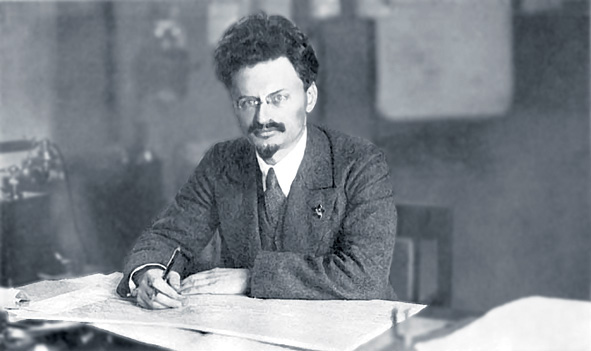
Leon Trotsky

Leon TrotskyLeon Trotsky, who was a political giant, built and led the Red Army from scratch. After Lenin’s death, it was Trotsky who led the struggle against Stalinism, for which he paid the ultimate price by his murder in 1940 at the hands of a Stalinist agent.

Over the recent period there has been an avalanche of books published to discredit Lenin, Trotsky and the Russian Revolution. First and foremost of these writers is Professor Robert Service, the author of several books, including one on Lenin and another on Stalin.

His latest book is a biography of Trotsky, which is an attempt to link all three figures and bind them to the crimes of Stalin. This amalgam is not a new method. Its aim is to prove that Bolshevism leads to Stalinism and totalitarianism and must be condemned in equal measure.

Anti-Communism

Professor Service comes from that breed of historians and intellectuals whose stock in trade is anti-communism. The task of these well-paid academics is to discredit Marxism, communism and revolution in general. Despite all the talk of “objectivity”, Service’s latest book contains nothing that is original, and is a rehash of all the old slanders and gossip against Leon Trotsky, one of the greatest revolutionary figures in history.

Robert Service dismisses Trotsky’s own autobiography, ‘My Life’, as well as the sympathetic and highly acclaimed biographies written by Isaac Deutscher and Pierre Broué, which contain, according to him, “highly disputable judgements”. Service wishes to “correct” these judgements with his own twisted conclusions.

Service is incapable of understanding history through the interaction of leaders, parties, classes and groups. He superficially reduces the historic struggle between Trotsky and Stalin as a personal or even psychological struggle, devoid of any class content or interests. “Stalin outplayed him. Trotsky did not go down to defeat at the hands of ‘the bureaucracy’: he lost to a man and a clique with a superior understanding of Soviet public life.” (p.4). This is to reduce historical events to trivia. Trotsky’s defeat is explained simply by personal failings and not by objective forces.

Liberal dilettantes, such as our learned professor, have never been able to understand revolutions or counter-revolutions. For them, such episodes are “excesses” or “accidents” that have deviated from the “normal” course of history. However, a revolution does not simply fall from the skies. Liberal bourgeois thought is incapable of understanding the movement of the masses and those who put themselves on the standpoint of the working class, as in the case of Lenin and Trotsky. Service could never understand Trotsky or what motivated him, his strengths and weaknesses. His motivation is simply to discredit Trotsky and the ideas he represents.

We are forced to leave aside every calumny thrown against Lenin and Trotsky, as these would require a book to answer. We have chosen to concentrate on the key questions raised by Service. According to the Professor, “Without Lenin, furthermore, Stalinism in the Soviet Union would have been impossible...” (Lenin: A Political Life, vol.3, p.xix). This is the crux of the matter. Were Lenin’s and Trotsky’s methods in essence no different from those of Stalin? Does Bolshevism lead to Stalinism? What was the struggle between Trotsky and Stalin all about?

The answers to these questions cannot be found in individual traits or personal combinations, although they play a certain role, but in the complex relationships between classes and different social layers and the objective conditions that predominate at the time.

Lenin’s and Trotsky’s lives were bound up with the revolutionary struggles of their age: the fight against tsarism, the development of Russian Marxism, the 1905 Revolution, exile, the war years, the revolutions of 1917, the conquest of power, and the founding of the Communist International. Trotsky lived on in the fight against Stalinism and the preparation for a new revolutionary international.

Revolutionary Struggle

In his outstanding autobiography, ‘My Life’, Trotsky explained “Thus I know well enough, from my own experience, the historical ebb and flow. They are governed by their own laws. Mere impatience will not expedite their change. I have grown accustomed to viewing the historical perspective not from the standpoint of my personal fate. To understand the causal sequence of events and to find somewhere in the sequence one’s own place – that is the first duty of a revolutionary. And at the same time it is the greatest personal satisfaction possible for a man who does not limit his tasks to the present day.”

Trotsky’s fall from power after Lenin’s death did not represent personal ineptitude but the changed relation of class forces in Russia and internationally. The victory of Stalin reflected the isolation of the revolution in a backward country, surrounded by hostile forces.

In Robert Service’s account of October, which he typically regards as a “coup”, there is one essential ingredient missing – the role of the masses on which the revolution is based. In the aftermath of the revolution, Service concludes “Most people in Russia and the rest of the world regarded the Bolshevik leadership as a gang of wild incompetents who could never sustain themselves in power.” (Service, Trotsky, A Biography, p.189). This is the view of the ruling classes, which Service takes as representing “most people”, but certainly not of the international working class which rallied to the cause of the Russian Revolution.

“Bolshevism,” explained Victor Serge, “is the unity of word and deed. Lenin’s entire merit consists in his will to carry out his programme... Land to the peasants, factories to the working class, power to those who toil. These words have often been spoken, but no one has ever thought seriously of passing from theory to practice.” (From Lenin to Stalin)

This was the essence of the revolution. In the civil war and imperialist intervention, the main aim of the imperialists was the violent overthrow of the revolutionary government and the murder of its leaders. In August 1918, a Social Revolutionary (member of the peasant party) shot and nearly fatally wounded Lenin. Trotsky was also the target of repeated assassination attempts by the White generals.

The first Soviet Constitution guaranteed every freedom for the workers. There was no thought whatsoever of a totalitarian state. All political parties, including the capitalist parties, were free to operate, accept for the fascist Black Hundreds. There was complete freedom of discussion and debate within the Communist Party. On the issue of the Brest-Litovsk proposals to sign a predatory peace treaty with Germany in 1918, for instance, Lenin was in a minority. He put forward the proposal that every group of citizens supported by 10,000 – 15,000 workers should have to right to issue their own paper if they wanted, the only way to democratise the press.

The October Revolution was largely a peaceful affair. “Hardly anyone was arrested”, noted Serge, “and those who were, were soon released. Among these were Krasnov, Ataman of the Cossacks, who took advantage of our leniency to start a civil war in the Don country – and Purishkievich, the anti-Semite leader.” (Ibid) The revolution was still very naive. As soon as these reactionaries were released they immediately took up arms against the workers’ state.

The first Soviet government was a coalition between Bolsheviks and Left Social Revolutionaries, a left wing split off from the Social Revolutionaries. This only came to an end when the Left SRs joined the Mensheviks and other counter-revolutionaries, and took up arms against the government. Only after the summer of 1918 did the revolution hit back in self-defence. Trotsky organised the Red Army in order to defend the revolution.
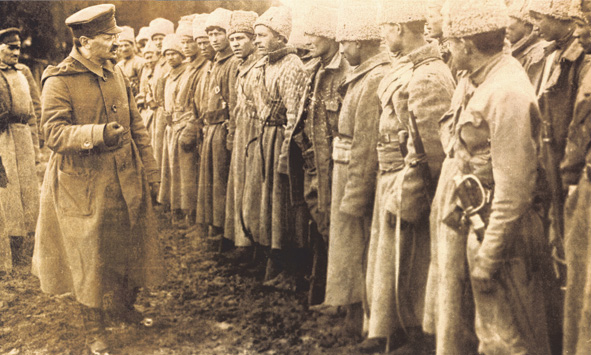
Leon Trotsky addresses Red Army troops during the Civil War, 1918

Leon Trotsky addresses Red Army troops during the Civil War, 1918“Lenin and Trotsky had become the Siamese twins of Russian politics”, states Service, “being joined at the hip in their determination to use ruthless measures including state terror against enemies.” (Trotsky, a biography, p.190). However, in a situation of civil war and imperialist intervention to overthrow the Soviet government, what were they to do, simply fold their arms and pray the counter-revolution would go away?

The counter-revolutionary White forces, backed by 21 foreign armies, took most of the country and carried out wide-scale atrocities against the workers and peasants. At one stage, the Soviet government only controlled Moscow and the surrounding area. The fate of the revolution was hanging by a thread. Trotsky succeeded in turning the situation around, but at enormous cost. War production and famine necessitated rationing in the cities and requisitioning in the countryside. This is the period of “war communism”, where everything was directed unavoidably to the war effort and military defence of the Soviet Republic.

Kronstadt Mutiny

This served to stretch things to the absolute limit. Relations between the peasants and the workers, the cornerstone of the revolution, reached breaking point. Peasant uprisings broke out in 1920 and early 1921. At this time the Soviet government was faced with a naval mutiny in Kronstadt. They had no alternative after negotiations broke down but to crush the rebellion. Failure to do so would have opened the door to military intervention against Petrograd. These Kronstadt sailors were not the same revolutionary sailors of October 1917, but new peasant conscripts under the influence of the counter-revolution. With the end of the civil war, the New Economic Policy was introduced to placate the peasants, allowing them to sell their surplus produce, which succeeded in bringing stability to the countryside.

In this life or death situation, the Bolsheviks had no alternative but to take emergency defensive measures. Incidentally, the same was true of Cromwell’s actions in defence of the English revolution against the Royalist reaction, or Robespierre’s defence of the French revolution against the feudal regime, or the measures of the Northern states against the slave-owning owners in the American civil war. “A party which had seemed doomed to defeat in mid-1918 triumphed by dint of determination, organisation and leadership”, admits Service. (Trotsky, a biography, p.245). But then goes on to attack such measures as “ruthless” and “terror against its enemies”.

The overthrow of the Soviet government would not have brought with it liberal democracy, but the military fascist dictatorship of the White generals. That was the alternative to Soviet power that the imperialists desired.

The Bolsheviks, while defending the revolution at all costs, never believed the revolution could be sustained for any length of time in a backward country like Russia. The fate of the Soviet regime depended upon the world revolution. Lenin believed that if the isolation was not broken, the Russian revolution would be doomed. He was prepared to sacrifice everything for a successful revolution in Germany. The only thing they could do was to hold on as long as possible until help arrived from the west. As we saw, the revolution did not collapse as Lenin had feared, but suffered a bureaucratic degeneration in the form of Stalinism.

Stalinism – the opposite of Bolshevism – grew precisely out of these objective conditions of isolation and terrible backwardness. After the civil war, the economy was completely shattered. The country was ruined and subject to famine and disease. The working class had become atomised. “The terrible crises and the closing down of factories have compelled people to flee from starvation”, wrote Lenin. “The workers have simply abandoned their factories; they have had to settle down in the country and have ceased to be workers.” (Collected Works, vol.32, p.199)

The introduction of the New Economic Policy in 1921 was a retreat, which gave concessions to the market. It saw the revival of capitalism in Russia, together with the merchant, petty employer, rich peasant and black marketer. This went hand in hand with the growth of bureaucratism in industry, the state and even the Bolshevik Party. Stalin, who was a secondary figure in the revolution, became the spokesman for this new social layer that was elbowing aside the working class.

State Apparatus

“Our state apparatus is so deplorable, not to say wretched, that we must think very carefully how to combat its defects”, complained Lenin. (Collected Works, vol.33, p.487). Things became so bad that Lenin and Trotsky formed a bloc in 1922 to fight the menace of bureaucracy. This struggle led to Lenin breaking off all personal relations with Stalin. Lenin stated he was preparing a “bomb” against Stalin. Finally, in his last ‘Testament’ Lenin recommended the Stalin be removed as General Secretary of the Communist Party and recommended Trotsky “as the most able man on the Central Committee”.

The wishes of Lenin’s Testament were not carried out due to the personal intrigues of both Kamenev and Zinoviev, who had made a rotten pact with Stalin to keep Trotsky out of power. Here we see the pernicious role of spite in politics and its unforeseen consequences.

Lenin’s death in January 1924 coincided with the defeat of the German revolution, which provided a double blow to the morale of the Russian workers. At this time, only one percent of the members of the Bolshevik Party had held a party card before March 1917. Many of the advance workers and communists had perished in the civil war. After these blows, through the agency of Stalin, the bureaucracy took control of the party and state apparatus. The weight of the Nepmen (petty capitalists created by the New Economic Policy) and kulaks (rich peasants) grew exponentially. The pressure of these hostile class forces fed into the party through the rising bureaucracy.

In late 1924, Stalin came forward with his anti-Marxist theory of ‘Socialism in one country’, which reflected the conservative outlook of the bureaucracy. This represented a complete break with the perspective of world revolution as put forward by Lenin. It also coincided with a campaign to discredit Trotsky who had established a Left Opposition in 1923 to restore party democracy.

Trotsky defended the position of revolutionary Marxism against the growing revisionism of Stalin. While Trotsky’s support rested upon the revolutionary workers, Stalin’s was based upon the bureaucratic reaction, the millions of petty officials, former tsarist functionaries, tsarist officers, bourgeois intellectuals, and so forth, who made their living in the apparatus of state, industry and party. Stalin became the “chief” of this caste, which now had its own material interests to defend. In 1926, when Lenin’s widow Krupskaya was close to the Opposition, she stated “If Lenin were alive today he would now be in prison.”

“Whoever understands history even slightly knows that every revolution has provoked a subsequent counter-revolution which, to be sure, has never completely thrown the nation all the way back to its starting point in the sphere of the economy but has always taken from the people a considerable part, sometimes the lion’s share, of its political conquests”, explained Trotsky. “And the first victim of the reactionary wave as a general rule is that layer of revolutionaries which stood at the head of the masses in the first period of the revolution, the period of the offensive, the ‘heroic’ period. This general historical observation should lead us to the idea that the matter is not simply one of the skill, the cunning, or the art of two or a few individuals, but of incomparably more profound causes.” (Trotsky - Writings 1935-36, p.171)

Stalin’s Revisionism

The years of hardship and defeat had borne down heavily upon the Russian masses. As the bureaucrats grew in power and insolence, the voice of the revolutionary workers became weaker. While the Bolshevik-Leninists around Trotsky drew to their banner tens of thousands of the best revolutionary fighters, and gathered sympathy from the advanced workers, this sympathy remained passive. They were exhausted and only a victory internationally could have stirred them into life. Meanwhile, the Stalinist bureaucracy railed against “permanent revolution” internationally and unnecessary upheaval at home. “We will build the socialist society in Russia!” they proclaimed. This found an echo in the weary and backward masses, which served to isolate the Bolshevik vanguard. “Therein lies the secret of the victory of the bureaucracy”, explained Trotsky. “Power is not a prize which the most ‘skilful’ win. Power is a relationship between individuals, in the last analysis between classes.” (Ibid, pp.176-77).

Dominant Position

Stalin used his dominant position to expel and exile Trotsky from the Soviet Union. By the mid-1930s, despite all the capitulations of former oppositionists around Zinoviev and Kamenev, Stalin decided to eliminate physically all those connected with the October revolution. The developing revolution in Spain was threatening to rekindle the enthusiasm of the Russian masses. This would have sounded the death-knell of the bureaucracy. As a result, Stalin waged a one-sided civil war against the Old Bolsheviks. This culminated in the purge trials of 1936-8, where those associated with October were physically eliminated. Millions perished in the camps and cellars of the secret police. For those who say, as Service does, that Bolshevism leads to Stalinism, we say that on the contrary, a river of blood separated Stalinism and Bolshevism.

The only way Stalinism could consolidate its rule was over the corpses of those communists and Trotskyists who remained true to the ideals of October. Trotsky fought Stalinism to the death. He refused to capitulate, as this would only serve to discredit the ideas of Marxism. Trotsky paid for this with his life.

Clean Banner

Despite all the terrible odds, and the murder of his close family and collaborators, Trotsky continued to defend the clean banner of Marx and Lenin against the horrors of Stalinism right up to the bitter end. The likes of Professor Service are repelled by this. Even Deutscher failed to understand the real Trotsky, believing he should simply concentrate on writing and not bother himself with organising the forces of a new revolutionary international. However, Trotsky regarded this task as the most important work of his entire life.

Despite the death of Trotsky, his ideas live on. The collapse of Stalinism, which he predicted, and the global crisis of capitalism, will once again make these ideas the most attractive ideas in the world.

“Time was when Trotsky was a frequent topic of public discussion at least outside the USSR. Those days are gone”, states Service. However, in today’s crisis, things are changing. There is a renewed interest in Lenin, Trotsky and their ideas. It is for this reason that Service has published his books. But they will have little effect.

We should study Trotsky’s writings, alongside other great teachers of Marxism, which are a treasure house of experience and theory. With these, the new generation can find the way forward in the eventual overthrow of capitalism and the establishment of world socialism. As for the likes of Professor Service, in the words of the Bible, let the dead bury the dead.

24 May 2007

Inspirasi Kaleidoskopis Jakarta

Resensi oleh Achmad Sunjayadi
Kompas, Senin, 14 Mei 2007


F de Haan pernah sesumbar bahwa ia telah meneliti Batavia sampai ke akar-akarnya. "Si Jago", demikian julukan arsiparis-peneliti ini, mengatakan Batavia telah ditelitinya seperti ia memeras sebuah jeruk segar hingga kering. Tak tersisa setetes pun.

Sesumbar De Haan ada benarnya karena, bila kita membaca buku ini, hampir sebagian besar para penulis artikel menggunakan De Haan sebagai sumber. Namun, De Haan melupakan satu hal, membicarakan Batavia atau Jakarta sekarang, tak akan ada habisnya. Buktinya, hampir setiap tahun persoalan yang dihadapi kota yang dahulu bergelar "Ratu dari Timur" itu beraneka ragam.

Menariknya, segala macam persoalan itu berakar dari berbagai masalah yang nyaris sama pada masa lalu. Sebut saja aspek demografi, morfologi perkotaan, lingkungan hidup, lalu lintas, hingga banjir. Dalam konteks itulah, buku Jakarta Batavia: Esai Sosio-Kultural layak dibaca, khususnya bagi bakal gubernur, penduduk, serta pendatang DKI Jakarta.

Buku yang membahas Jakarta ini merupakan kumpulan artikel yang ditulis oleh para ahli berbagai latar belakang disiplin ilmu dari luar maupun dalam negeri. Mulai dari sejarah, sosiologi, antropologi, geografi, linguistik, arsitektur, bahkan sastra. Suatu pendekatan yang semestinya juga dilakukan oleh para pengelola serta aparatur ibu kota negara ini yang memiliki beragam masalah.

Titik tolak yang digunakan buku ini bukan berdasarkan tematis, tapi kronologis. Yang merentang dari masa VOC (Vereenigde Oost-Indische Compagnie), abad ke-19, periode akhir masa kolonial hingga periode modern pascakemerdekaan.

Simak saja uraian Blussé membahas ritual diplomatik internasional pada periode awal Batavia. Ia menuturkan bagaimana para pejabat VOC harus mempelajari etiket dan protokol diplomatik. Berbagai upacara penyambutan, seperti tur dengan kereta kuda, defile pasukan bertombak, tembakan salvo hingga diisapnya sebatang pipa cangklong, harus diketahui oleh pejabat VOC.

Lalu ia membandingkan dengan penyambutan tamu negara masa kini. Melesat dengan kecepatan penuh dari bandara ke penginapan mereka, didahului dan diikuti rombongan polisi militer dengan raungan sirine dan lampu menyala-nyala. Tanpa memberi kesempatan kepada penduduk Jakarta untuk ber- tatapan dengan tamu pembesar asing itu (hal 36).

Masalah kesehatan serta nyamuk yang hingga sekarang juga menjadi masalah serius Jakarta ternyata juga merupakan persoalan pada masa lalu. Ironisnya, hal itu seolah menjadi persoalan yang tak kunjung padam. Masalah kesehatan pada masa VOC inilah yang dibahas lugas oleh Van der Brug.

Rumah sakit kompeni yang seharusnya membuat pasien menjadi sehat justru semakin membuat pasien sakit bahkan meninggal. Para pegawai senior VOC, kalau masih menyayangi nyawa, disarankan untuk dirawat di rumah saja daripada dirawat di rumah sakit yang jorok, kotor, penuh sesak (hal 51). Bagaimana pula dengan pelayanan rumah sakit pada masa kini?

Menurut penduduk, penyakit mereka berasal dari "uap jahat" yang ditengarai karena pendangkalan pantai yang dipenuhi sampah, bangkai ikan busuk. Tidak hanya itu, kanal yang tercemar, kuburan di halaman gereja, kualitas air, penebangan hutan, penggalian saluran air di sekitar kota hingga pencemaran Sungai Ciliwung karena adanya pabrik gula dituding sebagai biang kerok penyakit ganas di Batavia (hal 52).

Pakaian antinyamuk

Nyamuk pun jadi sasaran kambing hitam. Bila masa kini yang ditakuti nyamuk demam berdarah (Aedes aegypti), pada masa VOC nyamuk malaria (Anopheles sundaicus) jadi momok menakutkan. Begitu berbahayanya hingga pada masa VOC orang mengenakan "pakaian antinyamuk" khusus. Dalam berbagai pesta makan malam adalah hal biasa setiap tamu mempunyai seorang pelayan pribadi yang bertugas mengusir nyamuk dengan kipas besar (hal 64).

Ketidaksehatan Batavia ini sangat terkenal hingga seluruh Eropa. Ketika Raffles yang menjabat letnan gubernur Jawa kembali ke Inggris pada 1816, ia ditugaskan ke St Helena menemui Napoleon. Pertanyaan pertama Napoleon, apakah Batavia masih tidak sehat? Ketika itu memang Raffles sedang menderita malaria-cachexie dan tampak kurus (hal 73).

Masalah keamanan wilayah Ommelanden (di sekitar) Batavia menjadi perhatian Remco Raben. Persoalannya adalah konflik antarkomunitas. Pada 1686, ketika sebuah gardu jaga di kota diserang bandit-bandit Bali, VOC memutuskan mengeluarkan peraturan rinci mencakup semua komunitas di Ommelanden.

Diangkatlah para kepala kampung dengan pangkat kapten. Mereka diberi imbalan tanah untuk diri mereka serta para pengikutnya. Dengan cara ini diharapkan berbagai komunitas dijauhkan dari dalam kota (hal 104). Salah satu contoh adalah Kapten Jonker yang memiliki tanah di dekat Sungai Marunda.

Bicara 'kepala kampung', Mona Lohanda dalam artikelnya menyebutkan, kepala kampung pertama yang diangkat pada 1620 adalah kepala kampung China, Kapitan China.

Berbeda dengan pengangkatan kapten China pertama yang tercatat dalam Resolutien van 't Casteel Batavia pada 11 Oktober 1620, VOC justru tidak memberi perhatian pada pengangkatan Inlandsche Kommandanten yang berasal dari berbagai 'suku' ini. Antara lain, Kommandant der Boegineezen en Makassaren (Bugis dan Makkasar), der Amboneezen en Boetonders (Ambon dan Buton).

Betawi Asli

Apakah kaum bangsawan dikenal dalam masyarakat Betawi? Pertanyaan inilah yang mendasari Yasmine Shahab dalam membahas pembentukan elite Betawi yang berpangkal pada sejarah prakolonial.

Dalam artikelnya Yasmin menampilkan sebuah perhimpunan bernama Al Fatawi Mangkudat yang menyatakan diri sebagai representasi aristokrasi lama Jayakarta pra-Batavia sehingga memberi para anggotanya hak untuk dianggap sebagai BA alias orang Betawi Asli (hal 213).

Karya sastra ternyata dapat juga dimanfaatkan untuk mengetahui kondisi masa lalu. Seperti artikel Gerard Termorshuizen yang menggunakan novel-novel PA Daum dalam mengungkapkan kehidupan kolonial di Batavia. Mulai dari gambaran kedudukan sosial, hobi pamer, kehidupan religius, hiburan dan kebudayaan, kaum Indo rendahan dan nyai hingga kaum pribumi miskin yang tertindas. Di sini tampak bahwa karya sastra terkadang bisa memunculkan gambaran lebih jelas tentang sebuah masyarakat ketimbang satu rak sarat naskah sejarah yang formal dan kaku.

Sementara itu, Huub de Jonge memusatkan perhatian pada orang Arab di Batavia. Kelompok etnis yang relatif kurang mendapat perhatian. Padahal, komunitas Arab di Batavia adalah komunitas Arab terbesar kedua setelah komunitas Arab di Surabaya. Ia membahas sejarah komunitas Arab di Batavia, ketegangan dan konflik dalam komunitas tersebut.

Susan Blackburn dalam artikelnya menyoroti persoalan hak pilih perempuan dan posisi perempuan di Batavia yang tampaknya merupakan persoalan rumit. Ia mengungkapkan sulitnya kerja sama antara kaum perempuan pribumi, Tionghoa, Belanda, dan Indo. Hal yang khusus dibahas adalah cabang Vereeniging voor Vrouwenkiesrecht (Perhimpunan Pemilih Perempuan) di Batavia yang belum pernah dikaji sebelumnya.

Gang TSS

Nama-nama tempat di JA[DE]BOTABEK merupakan hasil penelitian memikat Kees Grijns yang menandai memori kolektif dan historis komunitas urban. Ia mengungkapkan berbagai nama jalan di Jakarta yang masih menunjukkan karakter asli pedesaan tempat itu, misalnya Kebon Sirih, Kebon Jeruk, atau Kebon Kopi.

Begitu pula nama jalan dengan nama haji tertentu yang menunjukkan kentalnya ikatan emosional orang Batavia dengan Islam tradisional. Namun, tahukah kita ada gang yang diberi nama 'Gang TSS'? Ternyata merupakan singkatan 'Tolong Sakit Sengsara' dan penghormatan terhadap seorang dokter Jawa yang membantu penduduk semasa penjajahan Jepang (hal 230).

Topik pelestarian alam di kawasan metropolitan Jakarta digarap Luc Nagtegaal dan Peter JM Nas. Mereka memaparkan kondisi kawasan hijau dari tipe-tipe yang berbeda, seperti taman, tanah kosong, taman milik pribadi, lapangan terbang, tanah makam, padang golf, lahan pertanian serta daerah resapan air. Mereka merumuskan pula sebuah teori tentang distribusi spasial kawasan hijau kota.

Artikel menarik lainnya adalah pandangan dari 'atas', yaitu kebijakan para pemimpin Jakarta dari masa ke masa karya Peter JM Nas dan Manasse Malo. Mereka menelaah kebijakan tersebut dengan menganalisis riwayat para wali kota dan gubernur pascaperang. Mulai dari Wali Kota Suwirjo hingga Gubernur Wiyogo (1945-1992).

Dengan kata lain gubernur, petinggi dan penduduk DKI Jakarta boleh saja silih berganti tapi persoalan yang dihadapi nyaris sama, berulang dan bahkan kian beragam.

Kekurangan buku ini (mungkin) kekurangjelian penyunting terjemahan pada halaman 1. Di sana tertulis tahun terbitan buku Oud Batavia karya si Jago, F de Haan 1992 seharusnya adalah 1922, seperti yang tercantum pada buku aslinya.

Secara umum buku yang dilengkapi peta, tabel, dan ilustrasi ini cukup menarik dan memberikan inspirasi bagi pakar sejarah, antropologi, sosiologi, tata kota, khususnya jajaran petinggi DKI Jakarta. Begitu pula para pembaca awam yang ingin mengetahui lebih banyak tentang gambaran persoalan ibu kota Negara Indonesia yang tak ada habisnya, kurang lebih bisa terpuaskan.

Achmad Sunjayadi Pengajar di Fakultas Ilmu Pengetahuan Budaya UI dan Erasmus Taalcentrum Jakarta


07 October 2006

Novel The Last Pope Ungkap Pembunuhan Paus Paulus I

Budi Setyarso - Komunitas Ruang Baca

Paus Johannes Paulus I, yang meninggal hanya 33 hari setelah dilantik menjadi pemimpin tertinggi Katolik pada 1978, diduga dibunuh. Ia yang secara resmi disebutkan terkena serangan hati diduga dibunuh karena berencana mereformasi secara radikal gereja.

Dugaan itu ditulis dalam sebuah novel, yang akan dipublikasikan tahun depan. Menurut penulisnya, Luis Miguel Rocha, 29 tahun, novel berjudul The Last Pope itu dibuat berdasarkan berbagai dokumen yang ia peroleh dari sumber di Vatikan.

Novel itu menguraikan secara rinci teori bahwa Paus Paulus I menjadi ancaman karena mengetahui pencucian uang yang melibatkan Bank Vatikan. Paulus I juga berencana meliberalisasi beberapa aspek doktrin gereja yang telah berusia berabad-abad.

"Ia ingin menjadi paus kaya yang terakhir. Paulus I ingin mendistribusikan kekayaan gereja, membuka gereja bagi perempuan, dan mengesahkan penggunaan alat kontrasepsi," kata Rocha menguraikan.

Novel mendeskripsikan pembunuhan Paulus I, sebagai hasil dari konspirasi yang melibatkan pejabat tinggi keuangan, sejumlah pemerintah negara Eropa, dan kelompok mafia. Mereka merekrut pejabat tinggi Roma, termasuk sekretaris pribadi Paus.

Penulisan novel ini menarik perhatian peserta Frankfurt Book Fair, pameran buku terbesar di dunia. Sedikitnya editor dari 50 negara menyatakan akan membeli hak cipta novel itu, kata penerbit Rocha.

Paus Johannes Paulus I meninggal pada 28 September 1978. Kematian ini menimbulkan berbagai spekulasi, karena perbedaan keterangan resmi dan faktanya. Apalagi, Vatikan menolak untuk melakukan otopsi.

Rocha bukan penulis pertama yang menulis seputar kematian Paus Paulus I. Pada 1984, penulis asal Inggris, David Yallop, menerbitkan In God's Name, yang menghubungkan kematian Paus Paulus I dengan korupsi di Bank Vatikan. Buku ini laku 6 juta kopi.

Namun, Rocha mengklaim, bukunyalah yang pertama ditulis berdasarkan dokumen dari Vatikan. "Ini buku fiksi yang berdasarkan fakta," kata editornya, Luis Corte Real.

Yang jelas, buku ini akan mengikuti jejak The Da Vinci Code karya Dan Brown yang terjual lebih dari 25 juta kopi di seluruh dunia.

03 February 2006

Imagined Communities

Ringkasan buku

Judul: Imagined Communities: Reflections on the Origin and Spread of Nationalism

Penulis: Benedict Anderson
Penerbit: Verso
Tahun terbitan: 1991 (edisi yang direvisi)
ISBN: 0860915468


Nationality, nation-ness, and nationalism are cultural artifacts whose creation toward the end of the 18th C was the spontaneous distillation of a complex "crossing" of discrete historical forces; but that, once created, they became "modular," capable of being transplanted to a great variety of social terrains, to merge and be merged with a variety of political and ideological constellations. Theorists of nationalism have encountered three paradoxes: (1)The objective modernity of nations in the eye of the historian vs. their subjective antiquity in the eye of nationalists. (2) The formal universality of nationality as a socio-cultural concepts vs. the particularity of its concrete manifestations. (3) The political power of nationalism vs. its philosophical poverty.

In order to address some of these problems, Anderson proposes the following definition of nationalism: it is an imagined political community that is imagined as both inherently limited and sovereign. It is imagined because members will never know most of their fellow-members, yet in the minds of each lives the image of their communion. It is limited because it has finite, though elastic boundaries beyond which lies other nations. It is sovereign because it came to maturity at a stage of human history when freedom was a rare and precious ideal. And it is imagined as a community because it is conceived as a deep, horizontal comradeship.

Nationalism has to be understood not in relation to self-consciously held political ideologies, but the the large cultural systems that preceded it. Nationalism arose at a time when three other cultural conceptions were decreasing in importance:
  • there were changes in the religious community. Nationality represented a secular transformation of fatality into continuity, contingency into meaning. The unselfconscious coherence of religion declined after the Middle Ages because of the effects of the explorations of the non-European world and the gradual demotion of the sacred language itself. The older communities lost confidence in the unique sacredness of their languages (the idea that a particular script language offered privileged access to ontological truth), and thus lost confidence in their ideas about admission to membership in the religious community.
  • there were changes in the dynastic realm. In the older imagining, states were defined by centers, borders were porous and indistinct, and sovereignties faded with one another. However, in he 17th C, the automatic legitimacy of the sacral monarchy began its decline and people began to doubt the belief that society was naturally organized around high centers.
  • was a conception of temporality in which cosmology and history were indistinguishable. In the Middle Ages, time was thought to be simultaneous; the modern idea was of homogeneous, empty time. They idea of a sociological organism moving calendrically through homogenous, empty time is a precise analogue of the idea of the nation, which also is conceived as a solid community moving steadily through history. These three changes lead to a search for a new way o linking fraternity, power, and time together.
Capitalism was especially important because the expansion of the book market contributed tot he revolutionary vernacularization of languages. This was given further impetus by three extraneous factors:
  • a change in the character of Latin
  • the impact of the Reformation, which led to the mass production of Bibles
  • the spread of particular vernaculars as instruments of administrative centralization.
Print languages laid the foundation for national consciousness in three ways:
  • they created unified fields of exchange and communication
  • they gave a new fixity to language
  • they created languages-of-power of a kind different from the older administrative vernaculars
However, the concrete formation of contemporary nation-states is not isomorphic with the determinate reach of particular print languages, one must also look at the emergence of political entities on the world stage.

Anderson is concerned with determining why it was Creole communities (those formed and led by people who shared a common language and common descent with those against who they fought) that developed early conceptions of their nation-ness well before most of Europe. There are 6 factors of Creole history that contributed to this:
  • the tightening of Madrid's control on these areas
  • the spread of the liberalizing ideas of the Enlightenment
  • the improvement of trans-Atlantic communication
  • the willingness of the "comfortable classes" to make sacrifices in the name of freedom
  • the ability of the administrative units to create meaning through the religious pilgrimage (refer to Victor Turner) and the internal interchangeability of mean and documents which helped created a unified apparatus of power
  • the rise of the newspaper which implies the refraction of events, even "world events" into a specific imagined world of vernacular readers
The failure of the Spanish-American experience to generate a permanent Spanish-American-wide nationalism reflects both the general level of development of capitalism and technology in the late 18th C and the "local" backwardness of Spanish capitalism and technology in relation to the administrative stretch of the empire. The Protestant, English-speaking people to the north were much more favorably situated for realizing the idea of "America."

The close of the era of successful national liberation movements in the Americas coincided with the onset of the age of nationalism in Europe. These "new nationalisms" were different in two respects: 1.) national print languages were of central ideological and political importance, and 2.) the nation became something capable of being consciously aspired to from early on due to the "models" set forth by the Creole pioneers. Vernacular print capitalism is important to class formation, particularly the rise of the bourgeoisie. Prior to this, solidarities were the products of kinship, clientship, and personal loyalties. The bourgeoisie, however, achieved solidarities on an imaginary basis through print capitalism. That is, they didn't know one another because of marriage or proper transactions, but because they came to visualize others like themselves through print. The nobility then were potential consumers of the philological revolution. As soon as the events of the Americas reached the European nobility through print, the imagined realities of nation-states became models for Europe.

From about the middle of the 19th C there developed "official nationalism" in Europe. they were responses by power groups threatened with exclusion from popular imagined communities (e.g., Russia, England, and Japan). They were a means for combining naturalization with retention of dynastic power. The model of official nationalism was also followed by states with no serious power pretensions, but whose ruling classes felt threatened by the world-wide spread of nationally imagined communities (e.g., Siam, Hungary).

The last wave of nationalism was the transformation of the colonial-state to the national state. This was facilitate by three factors:
  • the increase in physical mobility
  • increasing bureaucratization
  • the spread of modern-style education
It was a response to the new-style global imperialism made possible by the achievements of industrial capitalism. The paradox of official nationalism was that it brought the idea of "national histories" into the consciousness of the colonized. In addition, this last wave arose in a period of world history in which the nation was becoming an international norm and in which it became possible to "model" nationness in a more complex way that before.

Nation-ness is "natural" in the sense that it contains something that is unchosen (much like gender, skin color, and parentage). It has an aura of fatality embedded in history. It is not, however, the source of racism and anti-Semitism. Racism erases nation-ness by reducing the adversary to his/her biological physiognomy. Nationalism thinks in terms of historical destinies, while racism dreams of eternal contaminations whose origins lie outside of history. The dreams of racism actually have their origin in ideologies of class, rather than those of nation.

Revolutions, such as those in Vietnam, Kampuchea, and China, are contemporary exhibits of nationalism, but this nationalism is the heir of two centuries of historic change. Nationalism has undergone a process of modulation and adaptation, according to different eras, political regimes, economies, and social structures. As a result, the "imagined community" has spread out to ever conceivable contemporary
society.

These three institutions of power profoundly shaped the way in which the colonial state imagined its dominion. The census created "identities" imagined by the classifying mind of the colonial state. The fiction of the census is that everyone is in it, and that everyone has one, and only one, extremely clear place. The map also worked on the basis of a totalizing classification. It was designed to demonstrate the antiquity of specific, tightly bounded territorial units. It also served as a logo, instantly recognizable and visible everywhere, that formed a powerful emblem for the anticolonial nationalism being born. The museum allowed the state to appear as the guardian of tradition, and this power was enhanced by the infinite reproducibility of the symbols of tradition.

Awareness of being embedded in secular, serial time, with all its implications of continuity, yet of "forgetting" the experience of this continuity, engenders the need for a narrative of "identity."
